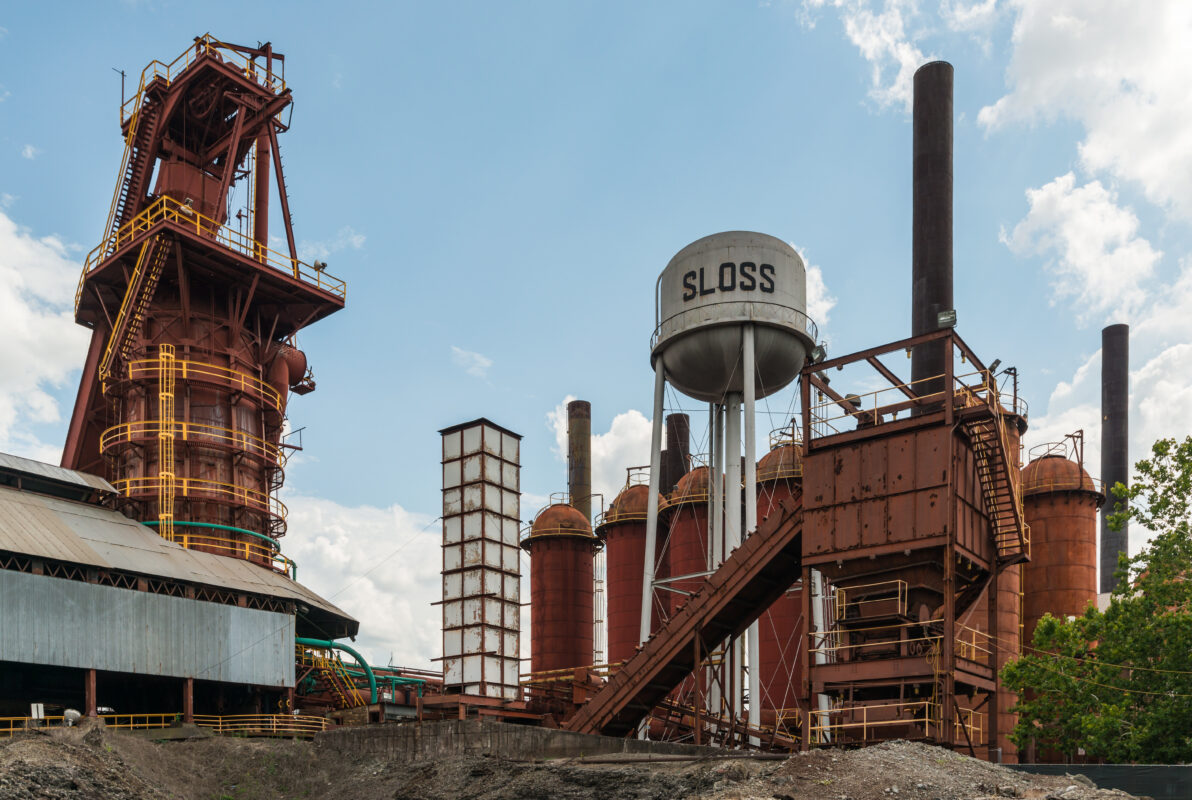
Deep in the heart of Birmingham, Alabama, sits an industrial giant frozen in time—Sloss Furnaces. Once a bustling center of iron production, this towering relic of the past has become one of the state’s most fascinating, eerie, and historically rich landmarks. But Sloss Furnaces isn’t just known for its contribution to Alabama’s industrial age; it’s also gained notoriety as one of the most haunted sites in the South. Paranormal investigators, curious tourists, and history buffs alike are drawn to its rusted catwalks and looming stacks. Step back in time and into the shadows as we delve into the powerful history and chilling tales of Sloss Furnaces.
The History
The Birth of an Industrial Giant
Sloss Furnaces was the creation of James Withers Sloss, a plantation owner, merchant, and railroad developer who was instrumental in Birmingham’s early development. After the Civil War, the Southern United States needed economic revival, and Sloss saw opportunity in iron. The area around Birmingham was rich in the key ingredients for iron-making—iron ore, limestone, and coal—all in unusually close proximity. It was a geologic jackpot, and Sloss wasted no time capitalizing on it.
The Sloss Furnace Company was formed in 1881, and construction began that June on a fifty-acre site donated by the Elyton Land Company. European-born engineer Harry Hargreaves, a pupil of British inventor Thomas Whitwell, oversaw the project and brought Whitwell’s innovative hot-air blast stove design to Birmingham for the first time. The furnaces—sixty feet high and eighteen feet in diameter—went into blast in April 1882. In its first year of operation, the facility produced 24,000 tons of high-quality pig iron, and Sloss iron earned a bronze medal at the Southern Exposition. The plant grew rapidly and became a key producer of pig iron, feeding the industrial demands of a growing nation. As railroads expanded, so did business. Sloss Furnaces helped put Birmingham on the map, contributing to the city’s nickname, “The Magic City,” earned through its rapid industrial growth.
Iron and Industry Through Decades
Sloss retired in 1886 and sold the company to a group of investors who guided it through a period of major expansion. The company reorganized in 1899 as Sloss-Sheffield Steel and Iron, though it never actually produced steel. With the acquisition of additional furnaces and extensive mineral lands across northern Alabama, Sloss-Sheffield became the second-largest merchant pig-iron company in the Birmingham district and, by World War I, one of the largest producers in the world.
Throughout this era, thousands of workers—the majority of them African American—toiled under harsh and dangerous conditions, enduring extreme heat, grueling hours, and physically perilous labor. The furnaces operated around the clock, producing tons of iron daily, and noise, soot, and smoke were constant companions to Birmingham’s growing skyline. Segregation was rigidly enforced at the site, with separate washrooms, time clocks, and even company picnics maintained until the 1960s. The company also made extensive use of convict labor, leasing prisoners to work in its mines under deplorable conditions—a practice it continued even after other major companies had abandoned it.
In the 1920s, Sloss underwent significant modernization. The No. 2 Furnace was rebuilt in 1927, incorporating numerous innovations developed by superintendent James Pickering Dovel, whose work earned Sloss a national reputation for industrial ingenuity. The site’s imposing blast furnaces, high-pressure boilers, and intricate piping created a labyrinth of mechanical might that seemed to breathe with a life of its own. But every empire has its decline. With shifting industry tides and advancing technology, Sloss Furnaces began to lose its edge.
The Shutdown and Historic Resurrection
By 1971, Sloss Furnaces ceased operations, pressured by tightening environmental regulations like the Clean Air Act, competition from higher-yielding ore sources in other regions, and the declining economics of older smelting operations. The Jim Walter Corporation, which had acquired the property, donated it to the Alabama State Fair Authority for possible redevelopment as an industrial museum. When the authority determined that redevelopment wasn’t feasible and made plans to demolish the furnaces, local preservationists formed the Sloss Furnace Association and lobbied to save the site. Their efforts succeeded—Birmingham voters approved a $3.3 million bond issue in 1977 to fund preservation. Sloss Furnaces was designated a National Historic Landmark in 1981 and opened its gates to the public as a museum in September 1983, becoming the first and only twentieth-century blast furnace in the United States preserved as a historic site.
Today, visitors can walk through Sloss’s towering structures, marvel at the iron-making machinery, and learn about the lives of the workers who powered the furnaces. The site hosts metal arts classes, concerts, festivals, and even weddings. But not all visitors come strictly for the history. Some come chasing shadows.
The Haunt
A Reputation Forged in Fire and Fear
Long before ghost tours and paranormal investigations put Sloss Furnaces on the supernatural map, workers whispered about eerie occurrences within its red-hot belly. The site’s dangerous reputation wasn’t just superstition—fatal accidents were tragically common. Workers risked scalding from hot pipes, poisoning from methane and carbon monoxide, crushing injuries from heavy machinery, and in the worst cases, falling into vats of molten iron. Dozens of workers lost their lives at the facility over its decades of operation, and the surrounding mines claimed many more.
One real and well-documented death that has become central to the site’s ghostly lore is that of a worker at a nearby furnace in the late 1880s. While working near the top of a blast furnace, he lost his balance and fell into the molten iron below, dying instantly. After that furnace was demolished in the early twentieth century, stories of his ghost reportedly migrated to Sloss Furnaces, where sightings of a spectral worker have been reported ever since. Over the years, this kernel of real tragedy became embellished with layers of urban legend—most notably the story of a fictional cruel foreman whose tale was popularized by a haunted house attraction that operated on the Sloss grounds for over two decades. While the fictional foreman makes for a dramatic story, the real history of dangerous conditions and genuine worker deaths at Sloss provides more than enough foundation for the site’s haunted reputation.
Paranormal Activity at Sloss Furnaces
Strange occurrences have been reported at Sloss Furnaces for decades, by security guards, maintenance workers, visitors, and paranormal investigators alike. Over one hundred reports of suspected paranormal activity have been documented in Birmingham police records, with the majority occurring during the nighttime hours of September and October—the same window that would have corresponded to the old graveyard shift.
Among the most commonly reported experiences are disembodied voices echoing through the facility. Some witnesses have described hearing shouted commands, as if production orders were still being called out across the factory floor. Others have reported whispered conversations in areas where no one else was present, particularly in the underground waterways that once served as part of the cooling system.
The site is also known for physical encounters with unseen forces. Visitors and former night security guards have reported being pushed, shoved, or touched by something invisible, particularly near stairwells and elevated platforms. One widely cited early account describes a night watchman who sustained injuries after being shoved from behind and hearing a deep voice angrily demand that he get back to work. Upon searching the grounds, he found no sign of any other living person.
Apparitions have been reported as well. A glowing, humanoid shape has been seen along the catwalks near the boiler area, and a shadowy figure is frequently spotted in the Blowing Engine Building—the oldest structure still standing at Sloss, dating to 1902. Workers at the site have described seeing the outline of a person from the corner of their eye, only for it to vanish when they turn for a better look. Visitors have also reported seeing a figure dressed in work clothes resembling early twentieth-century overalls. In one account, a photographer visiting the site to capture its industrial architecture saw a man standing in the distance and waved, assuming it was another visitor. The figure didn’t move, and when the photographer looked away briefly and glanced back, the man had vanished. A review of his photographs later revealed a faint silhouette near the furnace where no one had been standing.
Sudden and dramatic drops in temperature have been reported in otherwise warm areas of the facility, and objects left in one part of the Blowing Engine Building have reportedly been found moved to another room. Doors in that building have also been observed opening and closing on their own.
Investigations and Media Attention
Sloss Furnaces has drawn the attention of paranormal investigators and television crews over the years. The site has been featured on the Travel Channel’s Ghost Adventures, during which crew members reported being physically struck by unseen forces and hearing unexplained footsteps. It has also appeared on other paranormal television programs. The first formal paranormal investigation of the site was conducted in 2005 by a group from Bardstown, Kentucky, whose members reported seeing an apparition on the water tower catwalk within moments of arriving—an experience that a tour guide confirmed matched one of the site’s most frequently reported sightings. Independent investigators have since conducted numerous overnight studies at Sloss, many coming away with recordings of unexplained sounds, anomalous thermal readings, and personal experiences they found difficult to explain.
Step Into the Shadows
Sloss Furnaces is more than just a historic iron plant—it’s a place where Birmingham’s industrial past and its ghostly legends are woven together in rusted steel and lingering memory. The real history of dangerous labor, tragic deaths, and relentless production has left an imprint that many believe goes beyond the physical. Whether the strange experiences reported there are echoes of the past, the product of an eerily atmospheric setting, or something genuinely unexplained, Sloss Furnaces remains one of those rare places where history and mystery occupy the same ground.
If you have a passion for history and a curiosity about the unexplained, Sloss Furnaces should be on your list. The site is open to the public for free self-guided visits, with guided historical tours and seasonal ghost tours also available. Bring your camera, your curiosity, and your nerve. Just be prepared—walking through Sloss after dark, with its towering machinery casting long shadows and the distant clang of metal echoing through empty corridors, you may find yourself wondering whether you’re truly alone.
Books Related To This Haunted Location
As an Amazon Associate we earn from qualifying purchases.