
Tucked away in the heart of the Ozarks, Fayetteville Square in Arkansas is more than just a charming downtown area — it’s a time capsule of history, haunted tales, and hidden mysteries. With its blend of quaint storefronts, lively public events, and preserved historic buildings, Fayetteville Square invites travelers to explore its colorful past and possibly uncover a few ghostly secrets along the way. While it’s best known for its farmers market, cozy cafés, and university-town spirit, those who wander its brick-lined sidewalks at night might just experience something a little… otherworldly. The square’s haunted reputation has even given rise to a dedicated walking ghost tour of the downtown area, drawing locals and visitors alike to hear the legends firsthand. If you’re a history lover, a fan of Southern architecture, or a ghost hunter looking for your next adventure, Fayetteville Square has stories to tell — and you’ll want to listen.
The History
Origins and the Civil War Era
The origins of Fayetteville trace back to the 1820s, when the first permanent settlers arrived in what was then Arkansas Territory — land that had long served as hunting ground for the Osage and was later inhabited by the Cherokee. Washington County was established in 1828, and the settlement that would become Fayetteville was chosen as the county seat. Originally called Washington Courthouse, the name was changed to Fayetteville in 1829 on the order of Postmaster General William T. Barry, to avoid confusion with another town named Washington in Hempstead County. Two of the commissioners who helped locate the county seat had come from Fayetteville, Tennessee, and the new name honored their former home. The town was incorporated on November 3, 1836, and by 1837, a new brick courthouse stood at the center of the square, establishing it as the nucleus of civic life.
During the American Civil War, Fayetteville endured dramatic turmoil. The Battle of Fayetteville on April 18, 1863, brought Confederate and Union forces into direct conflict within the city. Confederate cavalry charged up from Big Spring while Union infantry and cavalry held their positions. Much of the fighting raged near the intersection of Dickson Street and College Avenue — an area that became known as “Bloody Corner.” The nearby home of Judge Jonas Tebbetts served as Union headquarters and bore the scars of the battle. Known today as Headquarters House, it still stands as a museum and headquarters of the Washington County Historical Society. Though the original courthouse on the square witnessed the upheaval of the era, it was the streets and structures surrounding it that saw the worst of the bloodshed.
The Rebuilding Period and the Rise of Commerce
After the war, Fayetteville underwent a major period of rebuilding and rebirth. With the town left in near-complete ruin, economic recovery was slow, but by the late 1800s and early 1900s, the square had blossomed into a thriving commercial center. Historic buildings rose along its edges, many of which still stand today, home to modern businesses, eateries, and boutiques.
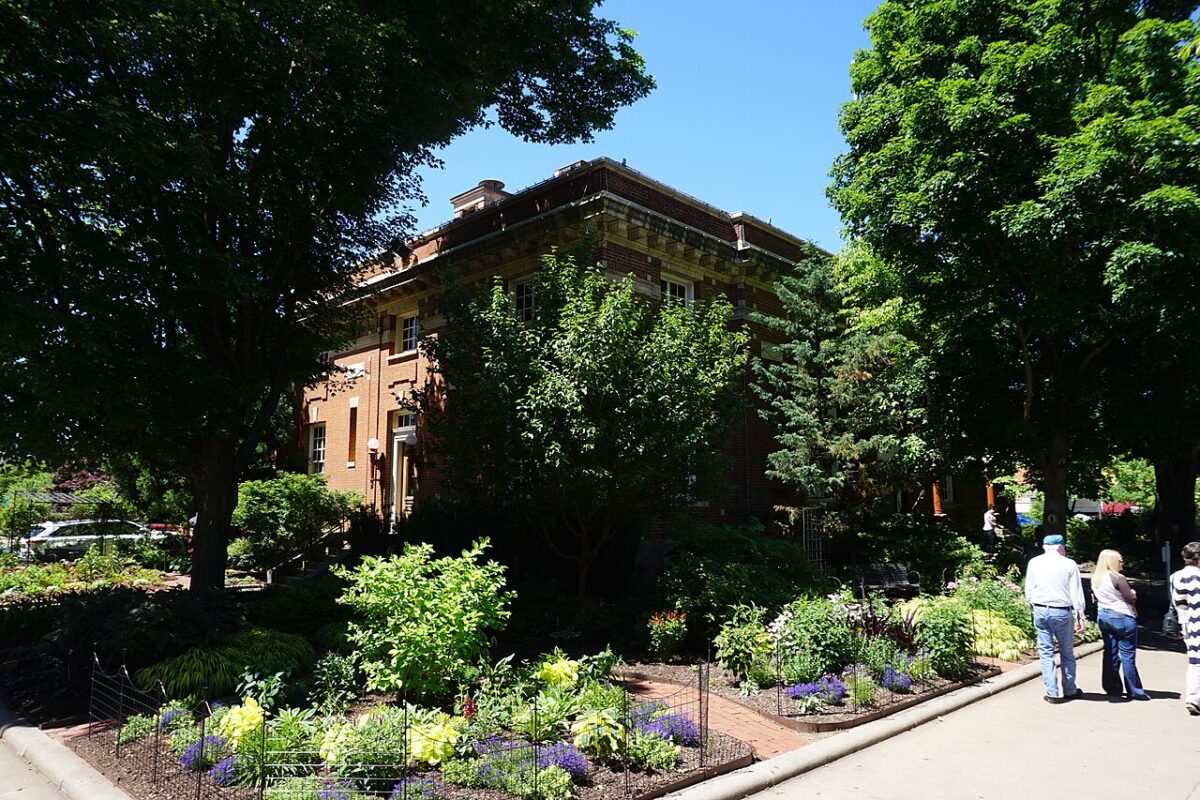
One particularly notable landmark is the Old Post Office, which sits at the very center of the square. Construction began in 1906 on the lot formerly occupied by the original Washington County Courthouse, which had been demolished in 1905 after a new courthouse opened on South College Avenue. Designed by architect James Knox Taylor, the Old Post Office officially opened in 1911. The three-story red brick building — cleverly designed to give the illusion of being a single story — features wide granite steps, white limestone arches, and elements of Neoclassical and Renaissance Revival architecture. Though it served as the city’s post office until the early 1960s, it narrowly escaped demolition in the 1970s when citizens rallied to save it. It was placed on the National Register of Historic Places in 1974 and has since housed a variety of businesses. Today, it operates as a restaurant and remains one of the most recognizable structures in downtown Fayetteville.
Preservation and Cultural Revival
In recent decades, Fayetteville Square has enjoyed a revival as both a cultural and historic treasure. Thanks to dedicated preservation efforts, many of the square’s original buildings have been restored or maintained with care. The square is the heart of major community events, including the beloved Fayetteville Farmers’ Market and the Lights of the Ozarks festival during the holiday season.
Despite its modern flair, the square’s preserved architecture and aging bricks radiate a sense of timelessness. For many, it’s impossible to walk around the square without sensing the energy of days long gone. Which brings us to one of Fayetteville Square’s lesser-known but increasingly whispered-about reputations: its status as a haunted hotspot.
The Haunt
For all its beauty and bustle, the Fayetteville Square area holds a darker, more mysterious side for those attuned to the unseen. With a history that includes war, loss, and nearly two centuries of human activity, the area has accumulated its share of ghostly legends — enough to sustain a dedicated walking ghost tour that covers the square and its surroundings.
The Courthouse Phantom
Perhaps the most well-established haunting associated with the square involves the old Washington County Courthouse. Though the original courthouse that stood at the center of the square was demolished in 1905, the courthouse tradition in Fayetteville has a long and sometimes grim history. The various courthouse buildings over the years served not only as seats of justice but also as holding cells for criminals, and conditions in early jails were known to be harsh. Local ghost tour guides describe the old courthouse as having “seen more than its share of violent retribution,” and say that many strange, unexplained experiences have been reported there over the years — enough to suggest that something, or someone, still lingers. The courthouse phantom is a fixture of the downtown walking tour and one of the best-known ghostly legends tied directly to the square.
Ghost Hollow and the Burning Bride
Just east of the downtown area, near the Confederate Cemetery on Rock and Willow Streets, lies a wooded area long known to locals as “Ghost Hollow.” The Confederate Cemetery itself is the final resting place of many Southern soldiers who perished in the battles of Pea Ridge and Prairie Grove, and its weathered headstones beneath towering oaks create an atmosphere thick with history and unease.
The oldest and most enduring legend associated with this area tells the tragic tale of a bride whose dress caught fire, killing her on what should have been the happiest day of her life. According to the legend, her screams of pain can still be heard echoing through the wooded thickets of East Mountain on certain nights. She is not the only specter said to prowl near the cemetery — a headless bride has also been reported in the area, and the nearby Walker family plot is said to be a source of ghostly sounds and apparitions after dark. Visitors to the Confederate Cemetery and the surrounding woods have described an overwhelming sense of unease, the feeling of being watched, and sounds that seem to have no earthly source.
The Woman in White at Tilly Willy Bridge
While not on the square itself, one of Fayetteville’s most famous and frequently retold ghost stories belongs to Tilly Willy Bridge, located within the city. The original bridge was built around 1928 and demolished in 2010, with a new bridge constructed directly over the original site in 2012. The haunting is linked to a car accident said to have occurred in the 1970s, in which a woman and her children were killed when their vehicle went off the bridge and plunged into the creek below.
Since then, drivers crossing the bridge at night have reported seeing phantom headlights approaching from the opposite direction, only to vanish as they draw near. Others have described seeing a ghostly woman in a white dress dancing or wandering in a nearby field. Perhaps the most unsettling accounts come from those who have parked on or near the bridge — legend holds that if you turn off the lights and let the windows fog, small child-sized handprints will appear on the glass. Knocking sounds, footsteps, and the sensation of being circled by something unseen have also been reported. The legend has become something of a rite of passage for locals and university students, particularly around Halloween, and the stories have persisted even after the original bridge was replaced.
A City Steeped in Spirits
Beyond these specific legends, the broader Fayetteville area has developed a rich tapestry of paranormal folklore. The Inn at Carnall Hall, originally built in 1905 as a women’s dormitory on the University of Arkansas campus, is said to be haunted by a former English professor who died suddenly of typhoid fever. Guests and staff have reported a floating apparition of a woman in a ball gown — notably without a head or feet — drifting through the corridors. At the Arkansas Air and Military Museum, housed in a historic all-wood World War II–era hangar at Drake Field, at least one male spirit — believed to be an aviator — has been reported making regular appearances, most often spotted in the museum’s library. These locations, combined with the legends of the square itself, have cemented Fayetteville’s reputation as one of Northwest Arkansas’s most quietly haunted cities.
Walk Among the Ghosts
Fayetteville Square offers more than lively events, cozy cafés, and charming Southern scenery — it’s a living testament to the layers of history that have shaped Northwest Arkansas. From the battle-scarred streets of the Civil War era to the spectral figures said to roam its historic buildings and wooded hollows, the square and its surroundings are a compelling destination for anyone drawn to haunted history.
The paranormal claims here are more subtle than those of Arkansas’s showpiece haunts like the Crescent Hotel in Eureka Springs, but that’s part of the appeal. These are stories rooted in local memory, passed down through generations and kept alive by residents who grew up hearing them. Whether you’re exploring the silent corridors near the old courthouse, walking the edges of Ghost Hollow at dusk, or scanning the nighttime sidewalks for something you can’t quite explain, the past feels close in Fayetteville. So grab your camera, lace up your walking shoes, and spend an evening letting the square’s secrets find you. In Fayetteville, history isn’t just remembered — some say it never quite left.
Books Related To This Haunted Location
As an Amazon Associate we earn from qualifying purchases.