
Disclaimer: This article is intended for informational and entertainment purposes only. If you choose to visit any abandoned or reportedly haunted locations, always do so legally, with permission if required, and with respect for the property and its history.
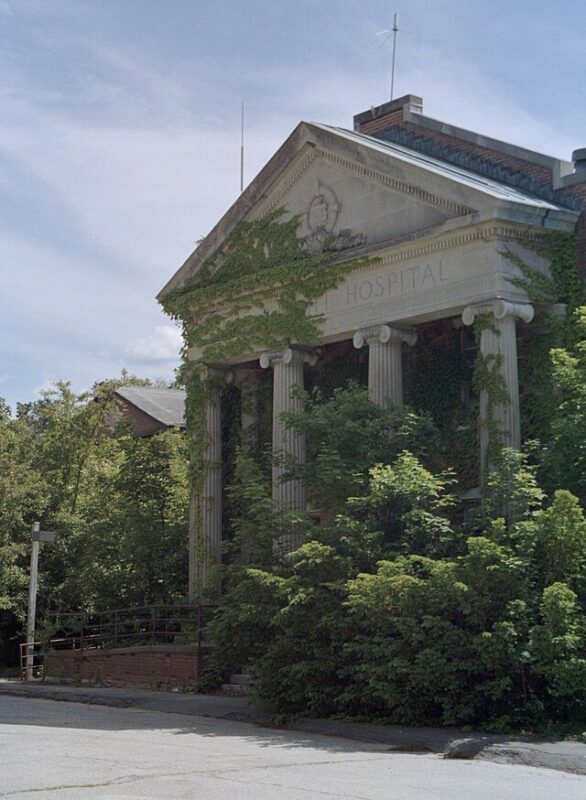
Nestled in the quiet hills of Mansfield, Connecticut lies a place where time has stood eerily still. The Mansfield Training School, once a bustling complex dedicated to housing and educating individuals with developmental disabilities, now sits silent and largely abandoned. But while the buildings may crumble, the echoes of the past remain loud and chilling. For paranormal investigators, urban explorers, and history buffs alike, the Mansfield Training School offers a spine-tingling blend of architectural decay, tragic history, and documented hauntings that continue to spark curiosity and fear. Whether you’re looking for ghostly encounters or to delve into Connecticut’s controversial mental health history, this site is a must-visit. Let’s explore the hauntingly real backstory that shaped this ghostly institution.
The History
From Farm Colony to Institution: Early Beginnings
The Mansfield Training School was established in 1917 through the merger of two separate institutions: the Connecticut Colony for Epileptics (founded at Mansfield in 1910) and the Connecticut Training School for the Feeble Minded, previously known as the Connecticut School for Imbeciles, which had operated in Lakeville since 1860. At its peak, the campus spanned approximately 350 acres in the rolling countryside of Mansfield and featured more than 50 buildings, most of which still stand today in varying states of decay. Its roots trace back to a time when cognitive and developmental disabilities were gravely misunderstood, and institutionalization was seen as both a compassionate and socially necessary solution.
The school was developed during a national push to relocate individuals with mental and developmental disabilities to rural “farm colonies,” where residents could not only live but also work by growing food, producing goods, and maintaining self-sufficiency. The theory was that fresh air, discipline, and structure could help these individuals lead more productive lives. Unfortunately, this soon devolved into a means for cheap labor and overcrowded conditions.
A Growing Institution with Harsh Realities
When the merged institution opened on July 1, 1917, it had 402 students in residence. The school’s population rapidly expanded over the following years. By 1932, there were over 1,000 residents, and at its peak, the facility housed approximately 1,800 individuals. What began with a mission to provide “training” turned into an overcrowded institution where residents were often neglected, overworked, and subjected to outdated medical treatments.
Education and therapy originally were parts of the curriculum. However, in many cases, residents were labeled “uneducable” and placed in dorm-style environments with minimal stimulation, interaction, or care. Over time, reports emerged highlighting poor conditions, underfunding, and mistreatment of patients. Many spent decades—even entire lifetimes—within its walls, often forgotten by society and their families. The state-run facility developed a notorious reputation by mid-century and became the subject of scrutiny and legal action.
The Decline and Controversy
The 1960s through the 1980s saw a dramatic shift in public views on mental health care. Nationally, there was a growing movement toward deinstitutionalization. Advocacy groups and whistleblowers brought attention to abuse and neglect within institutions, including Mansfield. As a result, lawsuits began to pile up against the school, citing inadequate educational opportunities, inhumane conditions, and violations of civil rights.
One of the most significant changes occurred in 1978, following the landmark lawsuit CARC v. Thorne. The case was filed by the Connecticut Association of Retarded Citizens (CARC) against the Department of Mental Retardation and its Commissioner, Gareth D. Thorne, arguing that the administration and staff at Mansfield Training School violated their clients’ constitutional rights and sections of federal law. After five years of litigation, the parties reached a consent decree in 1984 that led to massive reforms across Connecticut and ultimately contributed to the closure of the facility.
The Mansfield Training School formally shut its doors on April 24, 1993, and its residents were transitioned into community-based care programs. While some buildings were repurposed by the University of Connecticut and other organizations—including the Bergin Correctional Institution—many structures remain abandoned, gradually succumbing to nature and time. In 1987, the Mansfield Training School and Hospital was listed on the National Register of Historic Places.
The Haunt
A Site of Local Legends and Paranormal Interest
With its long, sometimes dark history, it’s no surprise that Mansfield Training School has gained a reputation not just as a relic of a bygone era, but as a location of interest for those curious about the paranormal. Local rumors about hauntings have circulated for years, and the site has become a draw for amateur ghost hunters and thrill-seekers—so much so that buildings have been padlocked and boarded up due to trespassing and vandalism.
The campus includes an old tunnel system that runs between buildings, originally used to transport residents during inclement weather. Most of these tunnels have since been filled in or blocked off, but they contribute to the eerie atmosphere of the grounds. Visitors often describe an unsettling quietness and a lingering sense that something feels “off” when walking the old grounds.
The Superintendent’s Residence: “Mansfield Mansion”
The most documented claims of paranormal activity center not on the institutional buildings themselves, but on the former superintendent’s residence, a colonial mansion on Stafford Road that was once part of the campus property. This house was featured on SyFy’s Paranormal Witness on September 28, 2011, in an episode titled “The Haunting of Mansfield Mansion.”
According to accounts from residents who have lived in the house over the years, experiences have included hearing unexplained footsteps, doors opening and closing on their own, strange creaks and knocks, and shadow figures. One former resident who lived in the house during the 1970s and 1980s later stated publicly that he remembered feeling a presence, finding doors open that he had closed, and having odd feelings—particularly when home alone.
Later occupants reported more intense experiences, including objects moving, growling sounds, and nightmares. Paranormal investigators who visited the property claimed to have recorded electronic voice phenomena (EVPs) and captured images of shadowy figures, though this evidence remains disputed and unverified.
The Broader Campus
Beyond the superintendent’s residence, claims about the main campus buildings are more general and less documented. One building, identified as Building 16, has been described in some accounts as a location where visitors have reported cold spots, unexplained noises, and apparitions—though these claims lack specific sourcing or verification. University officials have stated that there have been no confirmed ghost sightings on the property.
It’s worth noting that while the Paranormal Witness episode and local legends have contributed to the site’s haunted reputation, these tales are grounded in personal experiences and anecdotal accounts rather than empirical evidence. The atmosphere of the decaying buildings—with old patient files, hospital equipment, and other remnants still scattered through the halls—creates a haunting environment even without any supernatural element.
Dare to Investigate
For paranormal investigators looking for their next great case file—or for history lovers who want to witness the poignant remnants of the past—the Mansfield Training School is a compelling, if eerie, destination. Its abandoned halls speak volumes about the people who lived and worked there, and the tales of hauntings breathe new life (or death?) into those long-forgotten stories.
While many buildings are on private property and may be off-limits due to safety and trespassing laws, guided tours and sanctioned paranormal investigations do occur periodically. Check with local historical societies or paranormal events groups to plan a legal visit.
The Mansfield Training School isn’t just another stop on the haunted New England trail—it’s a place where history and hauntings collide. So, grab your EMF meter, power up your voice recorder, and prepare for an unforgettable exploration into one of Connecticut’s most notorious and chilling relics. Who knows what lost souls might be waiting to make contact?
Books Related To This Haunted Location
As an Amazon Associate we earn from qualifying purchases.