
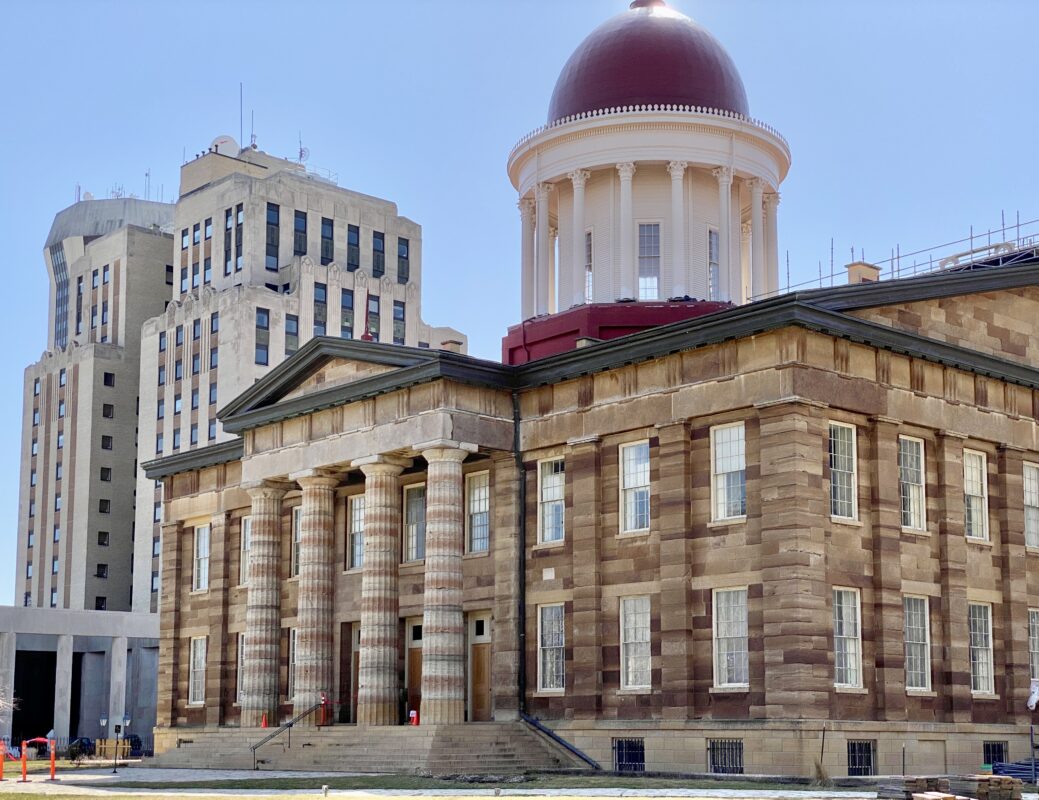
Looking for a destination packed with political drama, 19th-century grandeur, and whispers of paranormal activity? The Old State Capitol in Springfield, Illinois offers all that and more. This iconic landmark isn’t just the heart of Illinois’ political heritage—it’s also a place where stories linger, footsteps echo after hours, and restless voices may be heard deep in its restored chambers. Whether you’re a history buff, a weekend traveler, or a ghost hunter seeking your next supernatural fix, the Old State Capitol will leave you spellbound. Let’s peel back the layers of this historic site to uncover its fascinating past—and perhaps some lingering spirits who refused to leave.
The History
A Symbol of State Pride (1837–1876)
The story of the Old State Capitol begins in 1837 when a caucus of nine Illinois lawmakers, including a young Whig Party lawyer named Abraham Lincoln, successfully lobbied to have the state capital relocated from Vandalia to Springfield. The Illinois General Assembly passed a law creating a two-year transition period, with the goal of moving the capital to Springfield by 1839.
Following architect John Francis Rague’s plans, workers erected the Greek Revival-style building between 1837 and 1840. The variegated yellow-brown limestone forming the structure’s exterior walls was quarried about six miles away at nearby Sugar Creek. The building served as the fifth statehouse of Illinois and operated as the Illinois State Capitol from 1840 to 1876.
The structure contained chambers for both houses of the General Assembly, offices for the Governor of Illinois and other executive officials, and a chamber for the Illinois Supreme Court. Its rotunda, graceful columns, and imposing dome embodied the public pride of a state on the rise. During the 1840s and 1850s, the building dominated the public square and became a center of political and cultural life in Springfield, hosting dances, benefit dinners, auctions, and other civic affairs.
The Lincoln Connection
This isn’t just any old government building—it’s the very place where Abraham Lincoln honed his legendary oratorical skills. Lincoln served his final term as a state lawmaker in this building from 1840 to 1841. As a lawyer, he pleaded cases before the Illinois Supreme Court housed in the building from 1841 to 1860 and made frequent use of the building’s two libraries.
It was in the Representatives’ Hall on June 16, 1858, that Lincoln delivered his famous “House Divided” speech after accepting the Illinois Republican Party’s nomination as candidate for U.S. Senator. The speech, which included the famous words “A house divided against itself cannot stand,” marked a pivotal moment in American political history and underscored the growing tensions over slavery that would eventually lead to the Civil War.
The Governor’s Room served as Lincoln’s informal campaign headquarters during the 1860 presidential election. After his assassination, Lincoln’s body was returned to this building and lay in state in the Representatives’ Hall in May 1865, where thousands of citizens paid their final respects before his burial at Oak Ridge Cemetery.
From Courthouse to Restoration
As a result of economic growth spurred by the American Civil War, the Old State Capitol was, by the 1870s, too small to serve the purpose for which it had been built. After the government moved into a new Capitol building in 1876, the old structure was turned over to Sangamon County to serve as the county courthouse.
From 1876 until 1966, the Old State Capitol underwent significant alterations. In 1898–1899, Sangamon County raised the historic structure 11 feet, added a third floor beneath it, and reconfigured the interior to hold circuit court rooms and office space.
In the early 1960s, the Civil War centennial rekindled interest in the historic structure. The county retroceded the Old State Capitol to the state of Illinois as a place of public assembly and museum of Lincoln history. To restore and preserve the building, workers completely dismantled it stone by stone and rebuilt it. The public areas were reconstructed to resemble the appearance of the building in 1860, when Lincoln last saw the capitol prior to his departure to Washington. The state also excavated the plaza underneath to construct an extensive office and parking complex.
In 1961, the Old State Capitol was designated a National Historic Landmark, primarily for its association with Lincoln and his political rival Stephen Douglas. The restoration was completed in 1969, when the building reopened to the public as a state historic site.
Modern Honors and Cultural Legacy
The Old State Capitol remains relevant in the modern political landscape. On February 10, 2007, then-Senator Barack Obama chose this site to announce his candidacy for President of the United States. Standing before approximately 17,000 supporters in bitterly cold weather, Obama invoked Lincoln’s legacy, declaring: “In the shadow of the Old State Capitol, where Lincoln once called on a house divided to stand together, where common hopes and common dreams still live, I stand before you today to announce my candidacy for president of the United States of America.”
Obama returned to the Old State Capitol on August 23, 2008, to announce that Senator Joseph Biden of Delaware would be his running mate. In 2022, a historical marker was placed on the building’s lawn to commemorate these historic announcements.
Today, the Capitol serves as a historic site managed by the Illinois Department of Natural Resources. It is open to the public for tours and educational events.
The Haunt
For ghost hunters and paranormal enthusiasts, the Old State Capitol offers more than historical allure. With its deep connections to Abraham Lincoln, the tragedy of his assassination, and the solemn public mourning that took place within its walls, this building has all the makings of a classic haunt. The site is a regular stop on Springfield’s ghost tours and has attracted the attention of paranormal researchers over the years.
The Spirit of Lincoln
The most commonly reported paranormal phenomenon at the Old State Capitol involves the spirit of Abraham Lincoln himself. Visitors and passersby have reported seeing an apparition of Lincoln walking on the sidewalk in front of the building. These sightings are consistent with reports of Lincoln’s ghost at other Springfield locations connected to his life, including his home and Oak Ridge Cemetery.
Phantom Footsteps
Local ghost tours that stop at the Old State Capitol Plaza share accounts of phantom footsteps heard in and around the building after hours. These unexplained sounds have become part of the folklore surrounding the site and are often attributed to the many legislators, lawyers, and citizens who walked these halls during the building’s active years.
A Lingering Sadness in Representatives’ Hall
Those who are sensitive to atmosphere have reported feeling a profound sense of grief and sadness in the Representatives’ Hall—the very room where Lincoln’s body lay in state in May 1865. An orb has reportedly been seen floating above the area where Lincoln’s casket was displayed for public viewing. Whether this represents residual energy from the thousands of mourners who filed through or something more, visitors often describe an emotional weight in this space that goes beyond mere historical awareness.
Cigar Smoke and Other Phenomena
Local ghost walk guides share accounts of the smell of cigar smoke wafting through areas of the building when no one is smoking—a phenomenon sometimes associated with 19th-century politicians who frequented these halls. The adjacent Lincoln-Herndon Law Offices, where Lincoln practiced law, are also included in paranormal tours of the area.
The Old State Capitol stands as one of America’s most significant political landmarks—a place where Abraham Lincoln rose to national prominence, delivered one of his most consequential speeches, and returned one final time to lie in state before a grieving nation. More than 180 years after its cornerstone was laid, the building continues to draw visitors who want to walk the same halls as Lincoln and stand in the very room where he shaped the course of American history.
For those attuned to the supernatural, the Old State Capitol offers something more: a chance to experience the lingering echoes of the past. Whether it’s the reported apparition of Lincoln himself, the phantom footsteps heard after hours, or the profound sense of sorrow that visitors describe in Representatives’ Hall, this meticulously restored building seems to hold onto its history in ways that go beyond brick and limestone.
History and mystery intertwine at the Old State Capitol. Visit during the day to explore its beautifully restored chambers and learn about Lincoln’s remarkable journey from prairie lawyer to president. Return for an evening ghost tour to hear the stories that don’t appear in the official guides. Either way, you’ll leave with a deeper appreciation for this extraordinary place—and perhaps a story of your own.
Books Related To This Haunted Location
As an Amazon Associate we earn from qualifying purchases.