Tucked among the rolling hills and time-worn landscapes of central Kentucky lies one of the most historic—and eerily compelling—battlefields in America. Perryville Battlefield is a must-visit destination not just for Civil War buffs, but for ghost hunters and paranormal investigators alike. This blood-soaked expanse, now eerily quiet, once echoed with the thunder of cannon fire and the cries of thousands of young men locked in mortal combat. While it now serves as a peaceful reminder of the past, many believe that not all of the soldiers who fought here have truly gone. If you’re seeking a destination where history and hauntings collide, Perryville Battlefield might just be your next road trip obsession.
The History
The Battle of Perryville: A Civil War Turning Point
On October 8, 1862, Perryville—then a small, unassuming Kentucky town of roughly 300 residents—became the backdrop for the largest and bloodiest Civil War battle ever fought on Kentucky soil. The conflict was part of the Confederate Heartland Offensive, a campaign to bring Kentucky into Confederate ranks. Confederate General Braxton Bragg’s Army of Mississippi faced off against the Union Army of the Ohio under Major General Don Carlos Buell. While Buell’s full army numbered nearly 55,000 men, only about 22,000 were engaged in the fighting, clashing with approximately 16,000 Confederates. What began as a desperate search for water during one of the worst droughts in memory turned into a brutal and chaotic confrontation.
An unusual atmospheric phenomenon known as an acoustic shadow prevented Buell, positioned just a few miles away, from even hearing that a major battle was raging. The Confederates achieved significant tactical success, pushing Union forces back across much of the field. However, Union reinforcements eventually stabilized the line, and Bragg—outnumbered, low on supplies, and now aware he faced the bulk of Buell’s army—withdrew during the night. Though the Confederates won a tactical victory on the field, the battle is widely regarded as a strategic Union victory. Bragg’s retreat through the Cumberland Gap into East Tennessee ended the Confederate campaign in Kentucky, and the state remained firmly in Union hands for the rest of the war. The cost was staggering: in a single day, more than 7,600 men were killed, wounded, or went missing. The fields were soaked in blood, and stories of men dying of thirst within sight of meager creeks still haunt visitors and historians alike.
The Aftermath and Preservation
The aftermath of the battle was grim. Union forces buried most of their dead in long trenches before pursuing Bragg, but Confederate dead remained unburied for days—some accounts say the bodies were partially consumed by wild hogs. Perryville residents were eventually pressed into service to help lay the dead in shallow graves carved into the drought-hardened soil. Many of the wounded were taken to makeshift field hospitals set up in private homes throughout the town. Several of those homes still stand today, some still bearing the handwriting of soldiers who scrawled their names, ranks, and hometowns on the walls while they convalesced—or died.
Over the years, the site faded into quiet farmland, but local historians and preservationists never forgot. Thanks to decades of ongoing efforts by the state of Kentucky, the American Battlefield Trust, and other partners, the Perryville Battlefield State Historic Site now encompasses 745 acres, with over 1,200 total acres preserved across the broader battlefield landscape. It has been recognized as a National Historic Landmark, and the American Battlefield Trust has called it one of the most intact Civil War battlefields in the country.
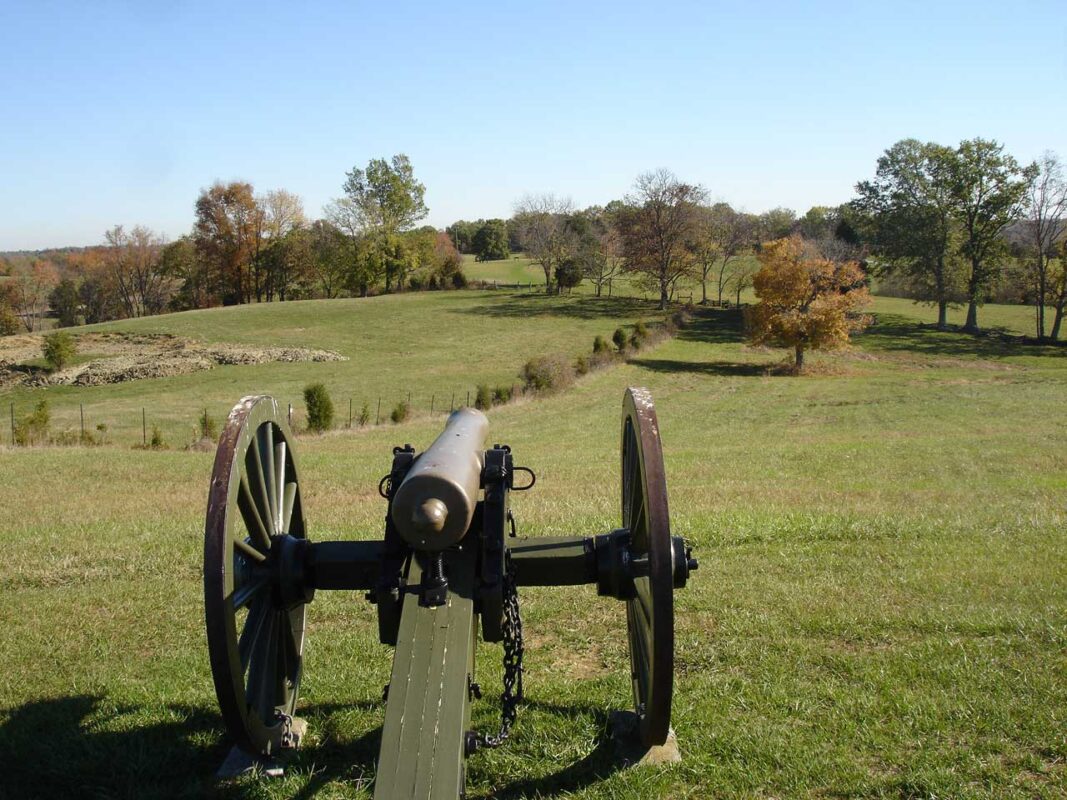
Visitors can explore over ten miles of interpretive trails, restored cannons, monuments, and a museum with exhibits and artifacts that bring the battle to life. However, many report that the truly immersive experience occurs when the sun sets and the battlefield begins to stir in ways that history books can’t explain.
The Haunt
Echoes of the Fallen
For well over a century, stories of ghostly activity have been told by townspeople, Civil War reenactors, and curious visitors. Perryville is often called one of the most haunted small towns in America, and the battlefield itself is widely considered one of the most haunted in the country. Even staff at the park have acknowledged that unexplained things happen on the grounds—from hearing voices in empty buildings to finding objects inexplicably moved overnight. The site officially offers paranormal tours for those who want to explore the battlefield after dark, and it has been featured on the Travel Channel’s Ghost Adventures, which investigated the battlefield and two of its former field hospital buildings.
Common experiences reported by visitors include hearing the sounds of cannon fire, bugle calls, and regimental bands playing on otherwise quiet nights. Others describe the sound of phantom horses galloping toward them from the tree line, so vivid that witnesses have braced for a deer or animal to burst through—only for the sound to simply vanish. Members of local paranormal investigation teams have described frequent EMF spikes and the capture of EVP recordings that appear to contain voices responding to questions.
The H.P. Bottom House and the Dye House
Two former field hospitals on the battlefield are considered hotspots for paranormal activity: the H.P. Bottom House and the John Dye House.
The H.P. Bottom House sat in the direct path of the fighting and still bears bullet holes in its walls. After the battle, it was used as a field hospital where amputations were common. A twelve-year-old boy who toured the battlefield shortly after the fighting later recalled seeing a pile of amputated limbs standing four or five feet high in a corner of the yard. An original door from the home, believed to have been used as a makeshift operating table, is said to still bear the bloody outline of a body. Visitors to the Bottom House have reported hearing footsteps on the upper floor when no one else is in the building, and two local women sitting on the home’s front porch one evening reported seeing a Confederate soldier walk out of the field, address them by saying “Ladies, the lamp will give our position away,” and then turn and walk back the way he came, fading from sight as he went.
The John Dye House served as the headquarters of Confederate General Simon B. Buckner and was later used as a hospital. Blood stains remain visible on the upper floor, where surgeries were performed. Paranormal investigators and park staff have reported a heavy, unsettling feeling inside the home, and it is frequently cited as the site of strange energy and unexplained phenomena.
Soldiers Who Never Left
Several visitors have reported encountering full-bodied apparitions of soldiers, sometimes alone and sometimes in groups, walking across the fields in period clothing before vanishing. One visitor driving through the area at dusk described seeing a young man in Civil War-era clothing—light blue trousers, a dirty white shirt, suspenders, and a slouch hat—walk across the road carrying a firearm over his shoulder. The driver realized the figure had no legs below the knee and watched as the soldier walked several steps and disappeared entirely. Others have described figures on horseback and eerie glowing lights drifting over the fields at night.
One of the most striking accounts involves visitors to the battlefield who have simply felt a strong, unexplained presence—a sensation of being followed, of someone walking just behind them or rushing up on them from behind, even when no one is there. Some describe being overcome with sudden waves of sadness, fear, or grief with no apparent cause.
Reenactors’ Encounters
Perryville’s annual reenactment draws performers and spectators from across the country, and strange experiences during these events are common. In one well-known account, two reenactors—both noted Civil War historians—were asleep in their tent when a man barged in and demanded to know the whereabouts of one of his soldiers. He gave his name and rank, then stormed out and vanished. When the historians later researched the names the stranger had given them, they found that both men were listed among those killed at the Battle of Perryville.
Other reenactors have described waking in the night to see ghostly figures standing over them, or hearing whispered prayers and moans that don’t match any living voice in the camp.
Listening to Perryville
If you’re searching for a location rich in both historical significance and paranormal potential, Perryville Battlefield deserves a spot at the top of your list. With its preserved grounds, emotional weight, and long history of unexplained encounters reported by skeptics and believers alike, it offers the rare combination of a place where you can walk hallowed ground by day and listen for its echoes by night. The large stretches of open battlefield, scattered historic buildings, and miles of walking trails provide multiple locations for investigators hoping to capture evidence—or simply experience something they can’t explain.
Whether you’re a seasoned paranormal investigator or a curious traveler, Perryville offers a genuine chance to connect with the past. Bring your EVP recorder, your EMF detector, your thermal camera—or simply your open mind. The battlefield doesn’t disappoint.
Plan your visit thoughtfully and respectfully. The soldiers of Perryville paid an extraordinary price on this ground, and the accounts of those who have encountered them suggest they may still have something to say—if only we’ll listen.