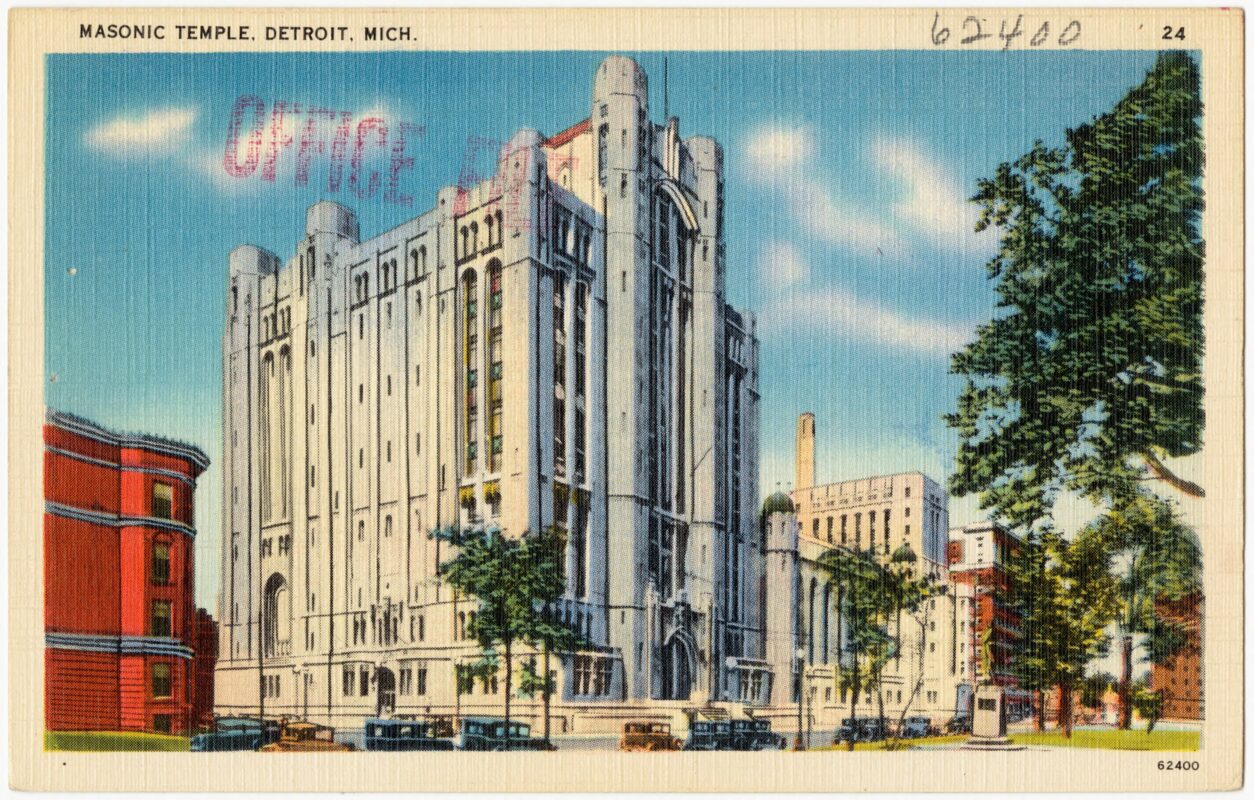
Detroit isn’t just famous for its music, cars, and gritty charm—it’s also home to one of the most extraordinary and mysterious buildings in America: the Detroit Masonic Temple. Whether you’re a history buff exploring neo-Gothic architecture or a ghost hunter chasing whispers in marble halls, the world’s largest Masonic temple won’t disappoint. With hidden passageways, symbolic designs, and unexplained activity, this monumental structure holds stories that go beyond bricks and stone. If you’re fascinated by the past and intrigued by the paranormal, the Detroit Masonic Temple should be at the top of your travel list.
The History
Origins and Grand Design
The Detroit Masonic Temple was conceived in the early 20th century when Freemasonry was thriving in America. By 1908, interest and membership in Masonic fraternities had grown so much that the Masonic Temple Association of Detroit—incorporated in 1894—began considering whether to enlarge their existing temple on Lafayette Boulevard or build an entirely new facility. They chose the latter, purchasing land on Bagg Street (now Temple Avenue) and commissioning the architectural firm of George D. Mason and Company to design the building.
George D. Mason was one of Detroit’s most prominent architects, responsible for landmarks including the Grand Hotel on Mackinac Island and the Detroit Yacht Club. He was also a 32nd-degree Freemason himself—making his surname a happy coincidence that suited the project perfectly. Mason designed the temple in the neo-Gothic style, a departure from the Egyptian and Greek styles typical of Masonic buildings. He believed that Gothic architecture best exemplified Masonic traditions, evoking the medieval cathedrals built by the operative stone masons from whom the fraternity drew its origins.
Ground was broken on Thanksgiving Day, 1920. The cornerstone was laid on September 18, 1922, during a ceremony attended by thousands of Detroiters, using the same trowel that George Washington—himself a Freemason—had used to set the cornerstone of the United States Capitol building. The temple was dedicated on Thanksgiving Day, 1926.
This architectural marvel consists of 1,037 rooms, including theaters, ballrooms, lodge rooms, hidden passageways, a chapel, a drill hall, and recreational facilities such as a swimming pool, gymnasium, handball court, bowling alleys, and a pool hall—though many of these amenities are no longer in use. The temple cost $6.5 million at the time, equivalent to roughly $88 million in today’s dollars, an enormous sum that proves how seriously Detroit’s Masons took their craft. Even at that price, the budget ran out before construction was fully complete—the top three floors were left unfinished, and a planned third theater and Olympic-sized swimming pool on the sixth floor were never completed.
Symbolism and Structure
Unlike many historic buildings that serve a single purpose, the Detroit Masonic Temple was designed as a multifunctional complex intended to host a wide variety of Masonic activities and public events. The massive building is composed of three connected sections: a 16-story, 210-foot ritual tower; a 7-story auditorium wing; and a 10-story Shrine tower. The temple contains:
- Two completed theaters and one unfinished — The main Masonic Temple Theatre seats over 4,400 guests and features one of the largest stages in the country. The Scottish Rite Cathedral (now the Jack White Theater) seats 1,586. A third theater on the seventh floor of the tower was planned to seat roughly 700 but was never completed due to lack of funds. Had it been finished, the Masonic Temple would have been the only building in the world to house three theaters under one roof.
- Seven Craft Lodge Rooms — each uniquely decorated to represent a different architectural tradition: Egyptian, Doric, Ionic, Corinthian, Italian Renaissance, Byzantine, Gothic, and Romanesque. All the artwork throughout the building, especially the ornate ceilings, was created under the direction of Italian artists.
- Ritual chambers — including a Royal Arch room and a Commandery Asylum for the Knights Templar, designed for private Masonic ceremonies rich in symbolic meaning.
- Two ballrooms — The Crystal Ballroom is particularly dazzling, with an arched ceiling and ornate chandeliers. The Fountain Ballroom, at over 17,000 square feet, can accommodate up to 1,000 guests and was the site of the very first Detroit Auto Show.
Much of the stone, plaster, and metalwork throughout the interior was designed by architectural sculptor Corrado Parducci, whose work gives the building an almost cathedral-like grandeur. The details can be dizzying, from intricate carvings to decorative brass floor plaques and elevator doors emblazoned with the symbols of the Craft.
The Great Decline and Revival
When Detroit’s economy began to shift in the latter half of the 20th century, so did the fate of the temple. Membership in Masonic fraternities declined, and major tenant groups eventually moved out—the Moslem Shriners left in 2003, and the Scottish Rite departed in 2006. Many of the temple’s rooms fell into disuse, and the financial burden of maintaining such an enormous structure on an annual budget of roughly $1.4 million became overwhelming. By April 2013, the building was reported to be in foreclosure over approximately $152,000 in back taxes owed to Wayne County.
In a twist worthy of Hollywood, rock musician Jack White of The White Stripes—himself a Detroit native—was revealed in June 2013 as the anonymous donor who had paid $142,000 of the outstanding debt the month prior, covering the vast majority of the bill. White had a deeply personal connection to the temple; his mother, Teresa Gillis, had been given a job as an usher at the theater when she was struggling to find work, and White grew up soaking in the neo-Gothic grandeur of the building’s corridors. In gratitude, the Masonic Temple Association renamed the Scottish Rite Cathedral the Jack White Theater. His act of generosity solidified the Masonic Temple’s status as a cultural and historical icon in the heart of Detroit.
The Haunt
If history lives in walls, then the Detroit Masonic Temple may be positively alive. With over a thousand rooms, unfinished spaces, underground tunnels, and a century of secretive rituals behind its limestone facade, the building has become a magnet for paranormal investigators and ghost hunters alike.
The Legend of George D. Mason
The most famous ghost story associated with the temple involves its architect, George D. Mason. According to a widely circulated urban legend, Mason poured his personal fortune into the building, went bankrupt during the Great Depression, was abandoned by his wife, and—overwhelmed by despair—jumped to his death from the top of the 210-foot structure.
It’s a dramatic and haunting tale, but it is important to note that historians have thoroughly debunked it. Mason did not go bankrupt, was not abandoned by his wife, and did not die by suicide. He continued designing buildings well into the 1940s and died peacefully of natural causes on June 3, 1948, at the age of 91, in his home at the Wilshire Apartments on Grand Boulevard in Detroit. The Detroit Historical Society has specifically addressed this myth, stating plainly that “while the story makes for a great Halloween horror tale, it is not true.”
And yet, the legend persists—and so, apparently, do the sightings. Over the years, security guards and staff have reported seeing the apparition of a forlorn man ascending the staircase toward the roof, often near midnight. Others have reported that the door to the rooftop is frequently found unlocked despite being secured, and that items go missing or turn up in unexpected places, behavior attributed by the lore to Mason’s restless spirit. Whether or not the historical man matches the ghost, the experiences reported by those who work in the building have been remarkably consistent over the decades.
Reported Paranormal Activity
Mason’s ghost isn’t the only unexplained presence reported within the temple’s walls. Across various parts of the building, visitors, staff, and paranormal investigators have described a range of unsettling experiences:
The Scottish Rite Cathedral (Jack White Theater): Witnesses have reported the sound of footsteps echoing through the empty 1,586-seat theater when no one else is present, along with faint, disembodied whispers from the shadows. The cathedral’s vast, ornate interior—designed to inspire awe during Masonic ceremonies—takes on an entirely different atmosphere after hours.
The Unfinished Spaces: The never-completed third theater, the empty swimming pool on the sixth floor, and other abandoned areas of the upper floors are frequently cited as sources of unease. Visitors describe an oppressive sense of being watched in these spaces, along with sudden and dramatic drops in temperature.
The Underground Tunnels: Utility passageways beneath the building have a reputation for causing handheld electronics to malfunction and giving visitors an intense, almost physical sensation of being observed. The narrow, dimly lit corridors amplify every sound, but some who have walked them insist the noises they’ve heard—shuffling footsteps, faint voices—had no earthly source.
Staff and Security Reports
Security guards who patrol the building at night have shared stories that have become part of the temple’s modern lore. Several have reportedly refused to patrol certain areas alone—particularly the upper lodge rooms and dark sub-levels. Commonly reported experiences include doors slamming shut with no breeze or draft to account for them, lights switching on and off by themselves, and shadowy figures glimpsed in corridors that vanish the moment they are approached.
The building’s eerie reputation has been further amplified by the secrecy surrounding the Freemasons themselves. The combination of Gothic architecture, hidden staircases, concealed passageways, and the remnants of century-old rituals creates an atmosphere where the line between history and the supernatural feels especially thin.
Paranormal Investigations and Public Interest
The Detroit Masonic Temple regularly hosts ghost tours alongside its historical tours, a testament to the public’s fascination with the building’s darker reputation. The building is a staple on lists of Detroit’s most haunted locations and has been discussed in various paranormal podcasts and media coverage, including segments on local Detroit television news. Whether or not you believe in ghosts, the palpable energy of the place is difficult to deny. Tours often leave guests with the lingering sense that they are not alone, even when surrounded by silence.
Step Inside the Shadows
Few places bring history and hauntings together like the Detroit Masonic Temple. As the world’s largest Masonic Temple—a title it has held since 1939—and a building layered in mystique, it is an irresistible destination for those who crave faded grandeur, ancient symbols, and stories that refuse to stay buried.
The temple offers all the ingredients for a paranormal hotspot: architectural oddities, unfinished spaces frozen in time, mysterious rituals stretching back over a century, and an urban legend so persistent it has taken on a life of its own—even after being disproven by the historical record. Combine that with the weight of Detroit’s own turbulent history, and you have a building where echoes from the past still speak, perhaps louder than they should.
So if you’re a ghost hunter, urban explorer, or paranormal enthusiast looking for your next great adventure, consider this your formal invitation. Dust off your EMF meter, pack your camera, and step inside the Detroit Masonic Temple—where history whispers and shadows dance.
Books Related To This Haunted Location
As an Amazon Associate we earn from qualifying purchases.