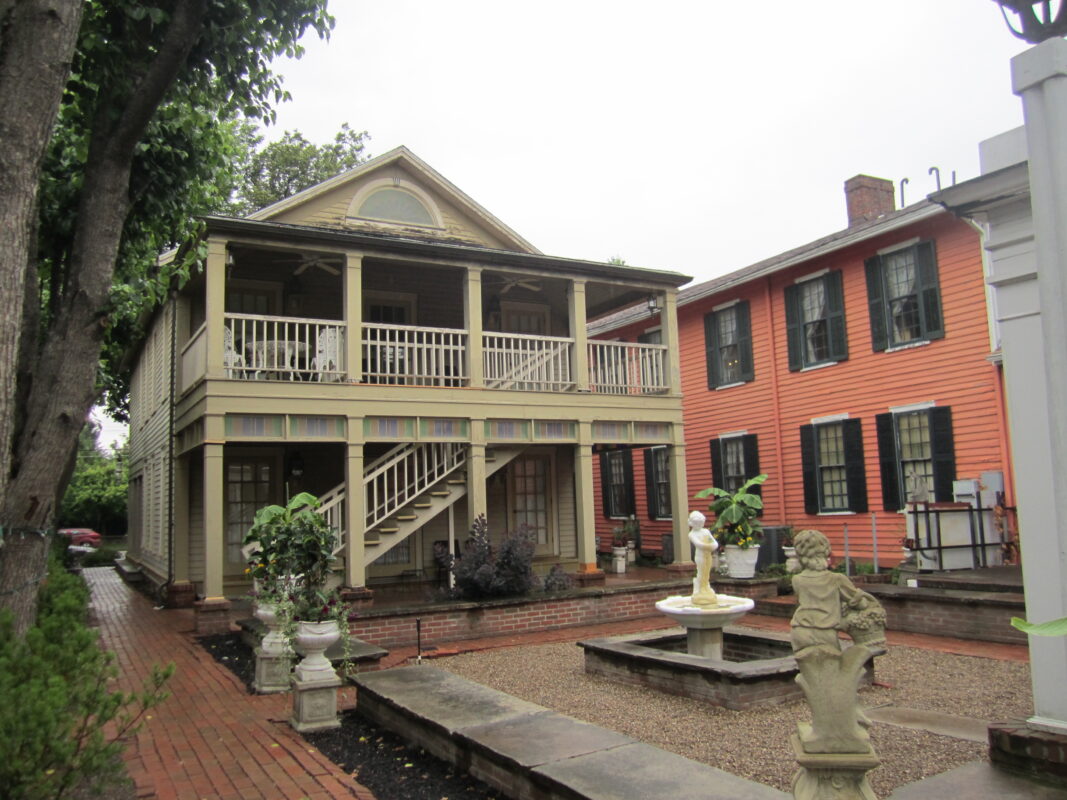
Nestled in the heart of Granville, Ohio, the Buxton Inn is more than just a charming historic inn and restaurant — it’s a portal to another time. With its early American architecture and timeless ambience, the inn feels like a slice of frontier Ohio. But as any seasoned ghost hunter or history buff will soon discover, the Buxton Inn isn’t just famous for its preserved charm and cozy hospitality — it’s also widely regarded as one of the most haunted locations in Ohio. The inn’s management prefers to describe the property as “spiritually active” rather than haunted, a distinction that speaks to the character of the spirits said to reside there. Whether you’re here for a peaceful stay or hoping to encounter something otherworldly, the Buxton Inn promises an unforgettable experience. So pack your EMF meter and a touch of courage — let’s journey into the past and unveil the secrets hiding behind these historic walls.
The History
Founding of the Buxton Inn
The Buxton Inn was established in 1812, making it Ohio’s oldest continuously operated inn in its original building. Built by Orrin Granger, a pioneer from Granville, Massachusetts, this early American structure began its life as “The Tavern” and quickly became a hub for travelers, postal service riders, and stagecoach passengers on the Columbus-to-Newark route. The building doubled as Granville’s first post office, and stagecoach drivers would sleep on straw and cook their meals over the open-hearth stone fireplace in the basement. The tavern also featured a ballroom, a dining room, and a stagecoach court, playing a key role in the development of Granville as both a social and economic center for the budding community. Granger was a friend and close acquaintance of General William Henry Harrison, who — according to local lore — once rode his horse up the courtyard steps and into the ballroom during a party in a fit of cheerful bravado.
Evolution Through the Centuries
Granger died young, at just 32 years of age in 1821, and the inn passed through a succession of owners while continuing to grow. The building was enlarged in the 1820s and 1830s. In 1858, James W. Dilley purchased the inn and renamed it “The Dilley House.” Then, in 1865, a man named Major Horton Buxton acquired the property and gave it the name it carries to this day. Despite the imposing title, “Major” was Buxton’s given first name, not a military rank. Buxton ran the inn until his death on June 15, 1902, and under his stewardship, the establishment became a well-regarded destination whose reputation for hospitality spread well beyond Granville.
Following the Buxtons, the inn was taken over in 1934 by Ethel “Bonnie” Bounell, a retired opera singer who had performed with the Manhattan Light Opera Company. Born Ethel Dorothy Houston in nearby Newark, Ohio, Bounell poured her heart into the inn, restoring it to what a 1946 Columbus Dispatch article described as its “pristine glory.” She lived in what are now Rooms 9 and 10, alongside her beloved cat — a 15-pound charmer she named Major Buxton after the previous owner. Bounell ran the inn for 26 years until her death on May 4, 1960. Her friend Nell Schoeller, who had helped manage the kitchen, inherited and continued operating the inn.
A Brush with American History
The Buxton Inn isn’t just historic in architecture and age — it has hosted a remarkable roster of notable guests over the centuries. Presidents William Henry Harrison, Abraham Lincoln, and William McKinley are all said to have stayed at the inn, along with author Harriet Beecher Stowe, composer John Philip Sousa, industrialist Henry Ford, and cellist Yo-Yo Ma. According to local accounts, the inn’s basement also served as a stop on the Underground Railroad, sheltering people fleeing slavery. Secret doors and hidden staircases within the building are said to date from that era. With each decade, the inn collected stories and spirits alike, becoming not just a place to sleep, but a venue through which time speaks — whispering tales of the past to anyone willing to listen.
Preservation and Legacy
By the early 1970s, time and the elements had taken their toll on the building, and there was serious talk of razing the old structure to make way for a parking lot. Local preservationist Robbins Hunter discussed the prospect of saving the inn with Orville and Audrey Orr, who purchased it in 1972 and undertook a loving restoration. That same year, on December 26, the Buxton Inn was added to the National Register of Historic Places. Over their 42-year stewardship, the Orrs expanded the business from just three guest rooms to a 20-room inn with a restaurant, bar, and wine cellar. In 2014, a partnership group led by preservationist Robert Schilling purchased the property and continued the restoration work. In October 2022, the inn suffered significant damage from a kitchen fire caused by an electrical issue, but it was repaired and renovated over the following months. Today, the Buxton Inn encompasses five buildings with 25 guest rooms, a full-service restaurant, and a tavern bar in the historic basement — appreciated by diners, overnight guests, and, some say, guests who never checked out.
The Haunt
The Buxton Inn has a documented history of reported paranormal activity stretching back to at least the 1930s. At least three former owners are said to linger on the premises, along with one very famous feline. The inn even offers “Ghostory Tours” at select times throughout the year, inviting visitors to explore the property and hear firsthand accounts from staff. In 2024, the inn was featured in an episode of PBS’s Columbus Neighborhoods titled “Ghosts, History, and the Underground Railroad: Granville Ohio’s Buxton Inn,” which explored both the building’s rich past and its reputation for the unexplained.
The Lady in Blue
The most well-known spirit associated with the Buxton Inn is “The Lady in Blue,” believed to be Ethel “Bonnie” Bounell, the beloved innkeeper who ran the establishment from 1934 until her death in 1960. Staff and guests over many decades have reported seeing a woman in a light blue dress — Bonnie’s favorite color — wandering the hallways, peering from windows, or entering guest rooms in the middle of the night.
In one well-known account from the early 1990s, a woman staying in Room 9 the night before a nursing conference reported that a woman in a blue gown entered her room during the night and held a long conversation with her. The guest had no prior knowledge of the inn’s haunted history and was deeply unsettled when she learned that no one else had been given a key to the room.
In another incident from the mid-1980s, a guest staying in Room 7 was awakened by the sound of someone flipping through the pages of her day planner, which she had left on an antique desk. She saw the door open and a woman walk in. She initially thought it was a colleague, before realizing it was the middle of the night. When she later described the woman to staff, she was shown a photograph of Bonnie — and identified her immediately.
The scent of gardenia perfume — Bonnie’s signature fragrance — is frequently reported by staff, sometimes appearing suddenly in rooms and hallways even in the dead of winter. Long-time employees say Bonnie’s presence, while startling, has never felt malicious. There are lighthearted stories as well: a cook who once made disparaging comments about Bonnie reportedly found her apparition in his bed that night — and claims she kicked him. A contractor working on renovations in the 1970s who scoffed at the idea of ghosts says he was shoved by an unseen force.
Major Horton Buxton
The inn’s namesake is also said to remain on the premises. Staff and guests have reported seeing an older man in an old-fashioned dark suit, most often near the fireplace in the main dining room. In one account, a waitress setting up tables before the restaurant opened looked up to see a man in a dark suit sitting by the fireplace. She hurried to the kitchen to ask a colleague whether she should serve him even though they weren’t technically open — but when they returned to the dining room, it was completely empty.
Major Buxton is also identified by the unmistakable scent of his pipe or cigar tobacco, which lingers in various areas of the now non-smoking inn. Staff who have worked at the Buxton for years say they can distinguish between the spirits by smell alone — tobacco for Major Buxton, gardenia for Bonnie.
Orrin Granger
The inn’s original builder also makes occasional appearances. He has been described as an elderly man wearing old-fashioned white or blue breeches. His sightings are less frequent than those of Bonnie or Major Buxton, but he has been reported on the first floor of the inn. In a more whimsical detail, he has been accused of stealing freshly baked pies from the downstairs pantry.
The Ghost Cat of Room 9
One of the inn’s most charming and frequently reported hauntings involves a spectral cat. Far from being a mystery, the ghost cat has a well-documented backstory. Bonnie Bounell’s beloved pet, a 15-pound cat named Major Buxton, was something of a local celebrity in his day. A 1946 Columbus Dispatch article described him as a “great big fellow” who could be found lounging on a pillow atop an antique chair near the front door. He was so popular with guests that they would request his company at dinner, and he had a well-known habit of nibbling on people’s ears.
The ghost cat is most commonly experienced in Room 9, where Bonnie lived. In 1989, two guests staying in Room 9 asked the manager the following morning if he was aware they had a ghost cat. One of the women reported that something jumped onto the bed beside her during the night, but when they searched the rooms, no cat was found. Many other guests over the years have described the same sensation — feeling the weight of paws landing on the bed, a purring near their ears, or a cat curling up at their feet, only to find the room empty when they turn on the light. Staff members have also reported seeing a small feline shape dart past in their peripheral vision on the first floor, or feeling something brush lightly against their legs — like a cat weaving between them — particularly outside Room 9. There are currently no living cats at the inn, though a cat sculpture sits at the base of the front stairs.
The Tavern and Basement
The basement of the inn, which once served as sleeping quarters for stagecoach drivers, a stop on the Underground Railroad, and later a speakeasy during Prohibition, is considered one of the paranormal “hot spots” of the property. Staff members have reported hearing voices, the sounds of mugs clinking, and chairs scraping across the brick floor when no one was present below. The heavy basement door is known to open and close on its own, and footsteps are frequently heard going up and down the narrow staircase.
There is also a spirit known as the “Tavern Boy” — said to be a young person who fell ill while traveling by stagecoach and was quarantined in the basement, where he died overnight. His ghost is said to sit on the basement stairs and to be somewhat mischievous, occasionally tripping people as they descend or tugging at hair. Another spirit associated with the basement area is said to be a boy named Henry, who reportedly died at the inn after being kicked by a mule.
In one memorable account from the 1970s, a 6’5″ bartender who was described as a “complete skeptic” was putting wine away in the cellar when he came running up the stairs, visibly shaken. He told his colleagues that someone had grabbed him from behind and knocked the wind out of him — though he was entirely alone.
During the COVID-19 pandemic, when the inn was closed and quiet, the inn’s management reported that paranormal activity actually seemed to increase, as if the spirits were unsettled by the absence of guests. Staff working alone heard sounds of revelry — clanking mugs, sliding chairs — coming from the empty tavern below.
More Than One Ghost — And More Than One Room
Paranormal experiences at the Buxton Inn are not confined to a single room or area. Guests across the inn have reported hearing footsteps in empty hallways, heavy doors slamming shut or creaking open by unseen hands, lights flickering or turning on by themselves, and a pervasive feeling of being watched. Room 7 is another frequently cited location for activity, including disembodied sounds and the feeling of an unseen presence.
Cold spots are a recurring theme in guest accounts. One visitor described walking into Room 7 and feeling what he likened to passing through a three-inch-thick wall of ice water — an intense, localized cold that vanished when he stepped back. In the dining room, a family reported that their child suddenly became freezing cold — lips and fingers turning blue — while everyone else in the room felt perfectly comfortable. When they moved the child to a different chair, he warmed up immediately. No cold air vent or fan could account for it.
Staff who have worked at the inn for decades note that the experiences are remarkably consistent over the years. The same spirits, the same scents, the same gentle (and occasionally mischievous) interactions are described by guests who often have no prior knowledge of the inn’s history or its resident ghosts.
Why You Should Visit the Buxton Inn
If you’re a ghost enthusiast, paranormal investigator, or simply someone drawn to stories that straddle this world and the next, the Buxton Inn should be at the top of your haunted travel list. Few places in Ohio — or even the Midwest — combine authentic early American history with such sustained and well-documented reports of paranormal activity. The inn offers all the modern comforts you’d expect — cozy rooms, fine dining, and welcoming hospitality — alongside the thrill of possibly encountering the unknown. You can book rooms known for their haunted reputations, dine in spaces once frequented by presidents and pioneers, and walk hallways where the scent of gardenia or pipe tobacco might appear without explanation.
Whether you’re here to experience a slice of Ohio’s past or to chase whispers from the beyond, one thing is certain: the Buxton Inn is waiting for you — with or without a ghostly greeting at the door.
Books Related To This Haunted Location
As an Amazon Associate we earn from qualifying purchases.