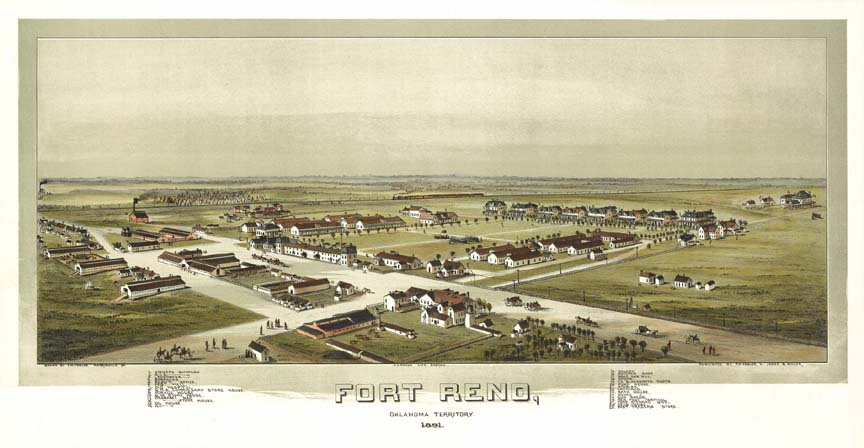
Just west of Oklahoma City, perched on the open plains near El Reno, lies Fort Reno, a place where American frontier history meets the unexplained. This former military post has witnessed war, incarceration, and untold stories whispered through time. Today, it’s a preserved site with stunning historic buildings — and a few ghostly guests who may not have left. Whether you’re a history buff, a paranormal investigator, or simply someone who enjoys unraveling tales from the past, Fort Reno invites you to step back in time — and perhaps beyond the veil.
The History
Roots in the Indian Wars
Established in 1874 during the tumultuous era of the Indian Wars, Fort Reno was initially created to provide military support for the Cheyenne and Arapaho Agency in the western part of Indian Territory (now Oklahoma). The fort was named in honor of General Jesse L. Reno, a Union general who died in the Civil War. Its presence was meant to secure peace during violent conflict between Plains tribes and encroaching settlers.
The post served as a base for Buffalo Soldiers — African American regiments like the 9th and 10th Cavalry — who played a significant role in frontier military engagements. At the time, the fort was a strategic outpost in a land undergoing rapid change, straddling a line between protectors and enforcers of America’s westward expansion.
From Active Duty to World War II
By the early 1900s, the need for frontier forts declined, and Fort Reno transitioned into a remount depot, providing training and care for Army horses and mules. During World War I, the fort trained cavalry officers and supplied animals for the war effort. But Fort Reno would take on yet another new identity during World War II — this time, as a prisoner of war (POW) camp.
Between 1943 and 1946, German and Italian POWs were housed at Fort Reno. These prisoners worked the land, built structures, and contributed to the upkeep of local farms under watch of the U.S. military. The POW chapel, built with prisoner labor, still stands today and serves as a somber reminder of that unique chapter in Fort Reno’s history.
The Present-Day Historic Site
Decommissioned in 1948, Fort Reno was transferred to the U.S. Department of Agriculture for research. While still used for agricultural research today, much of the site has been preserved for public visitation. Remarkably, the original officer quarters, guardhouse, stables, and the post cemetery remain intact. In fact, the Fort Reno Cemetery is one of the most visited locations on site, containing the graves of Buffalo Soldiers, early settlers, and even some of the former prisoners of war.
The preserved buildings and eerie quiet of the plains make Fort Reno fertile ground for both historical exploration and paranormal curiosity. Whether you’re walking the officers’ row or stepping into one of the original barracks, the past always seems to linger — sometimes more tangibly than you’d expect.
The Haunt
With its long and often tumultuous past, it’s no surprise that Fort Reno has become a hotspot for ghostly activity. Paranormal investigators and thrill-seekers alike have reported strange phenomena over the years, ranging from unexplained sounds and shadowy figures to ghostly apparitions that defy explanation.
The Haunted Guardhouse
One of the most active locations on the fort is the old guardhouse. Several visitors and investigators have reported eerie sounds, like rattling chains, disembodied voices, and sudden drops in temperature. Legend has it that this was the site of intense disciplinary actions in the fort’s early years, including solitary confinement — and perhaps even deaths. Some believe that the tormented spirits of soldiers or prisoners still reside here.
Apparitions in Officers’ Row
The southern facing officers’ quarters, particularly Quarters #16, have stories of their own. Shadowy figures have been spotted peering through windows. Nearby, whispers are sometimes heard when no one is around. Paranormal teams equipped with thermal imaging and motion detectors have picked up unusual readings inside the now museum-like spaces. A common sensation experienced? That you’re being watched — even when alone.
The Cemetery’s Lingering Spirits
The Fort Reno Cemetery is one of the most spiritually active areas onsite. EVP (Electronic Voice Phenomena) sessions conducted by multiple paranormal groups have asked questions and received inexplicable responses through recorders. On quiet nights, glowing orbs have been photographed hovering above headstones. Some say Buffalo Soldier spirits remain to guard their final resting place. Others suspect that energy from the POW era has marked the soil permanently.
The German POW Chapel
Built by German prisoners during WWII, the chapel is not only a historical monument but also a location of documented supernatural activity. Visitors claim to have seen fleeting images dressed in vintage military uniforms or heard organ music playing — even though no functioning organ exists in the building. The energy in the chapel is frequently described as both heavy and reverent.
Documented Investigations
Fort Reno has been visited by numerous ghost hunting groups, including amateur investigators and nationally-recognized paranormal teams. Equipment sensitive to EMFs (electromagnetic fields) frequently lights up in rooms with no electronic sources. Thermal cameras have captured cold spots in contained areas, and K2 meters used in the German chapel routinely spike in patterns that suggest intelligent responses to questions.
Some investigators go so far as to call Fort Reno “one of Oklahoma’s most authentically haunted locations.” For sensitive individuals, merely stepping onto the property is enough to elicit chills and unease. But for the curious and the brave, these well-preserved grounds offer a rare chance to connect directly with the past — and perhaps something beyond it.
Why Ghost Hunters Should Visit Fort Reno
Few places in the country offer such a potent combination of deep historical significance and active paranormal phenomena as Fort Reno. This site isn’t just a dusty relic — it’s alive with stories, some proud, some painful, and others inexplicably supernatural. If you’re investigating the unknown or simply wandering in search of goosebumps, Fort Reno delivers both in spades.
The fort is open for guided and self-guided tours, and the staff often hosts special candlelight ghost tours where guests can walk the haunted grounds after dark — a must for the serious paranormal explorer. Bring your EVP recorder, your thermal imager, and your curiosity. Whether you’re seeking lost Civil War echoes, whispering Buffalo Soldiers, or mischievous spirits of long-passed prisoners, Fort Reno invites you to experience the great unknown firsthand.
Ready to meet the spirits of Oklahoma’s past? Pack your gear, prepare your senses, and head west to Fort Reno. The history is undeniable — and the hauntings unforgettable.
Books Related To This Haunted Location
As an Amazon Associate we earn from qualifying purchases.