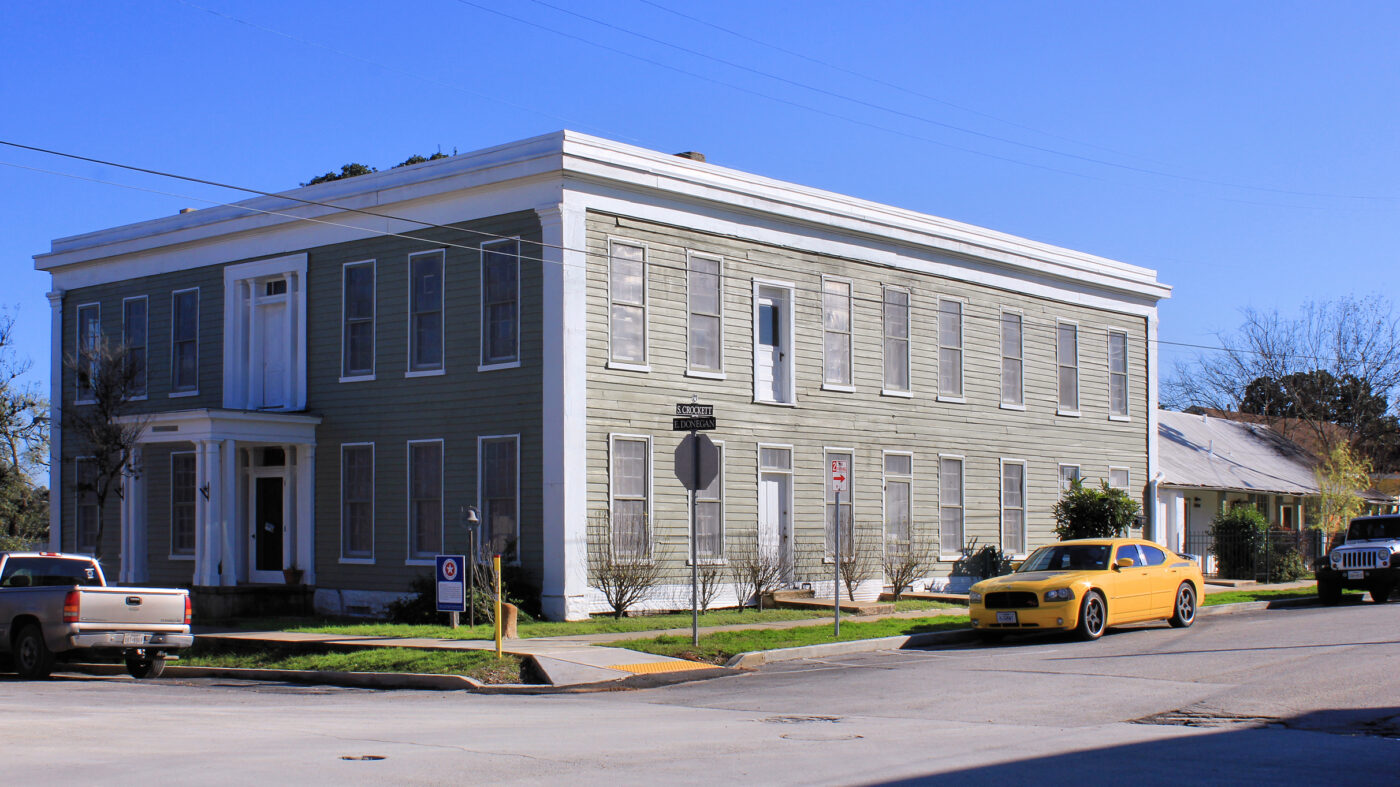
Deep in the heart of Texas sits a restless relic of the Old West, steeped in frontier grit, tragedy, and ghostly remembrance. The Magnolia Hotel in Seguin, Texas, is more than just a beautifully restored piece of history — it’s a living museum of Texas lore and legend. With its roots tracing back to 1840 and a long record of ghostly guests who apparently never checked out, it’s a must-visit destination for those with a thirst for history and a fascination with the paranormal. Whether you’re a historian, ghost hunter, or someone who simply loves a spine-chilling backstory with your vacation plans, the Magnolia Hotel is calling.
The History
A Frontier Cabin with a Storied Past
Located roughly 30 minutes east of San Antonio, the Magnolia Hotel is one of the oldest buildings in Seguin. The original structure dates back to 1840, when Texas Ranger and Seguin co-founder James Campbell built a two-room log cabin using timber originally intended for a frontier stockade. Beneath the cabin, a large basement was hand-excavated from solid rock, serving as a shelter during Comanche raids and occasionally as the town’s first jail — one that earned a reputation as the worst in all of Texas.
Campbell lived in the cabin only briefly before he was ambushed and brutally killed by Comanche warriors in retaliation for the Council House Fight of 1840 — a peace negotiation in San Antonio that ended in bloodshed. After his death, the cabin was sold to businessman Joseph F. Johnson, who expanded it and transformed it into Seguin’s first stagecoach stop. In 1846, the property was sold again to Jeremiah Strother Calvert, a prominent local figure and descendant of Lord Baltimore.
Around 1844–1846, a three-room addition was constructed at the rear of the cabin using limecrete — an early concrete mixture of lime, sand, and gravel pioneered locally by Dr. John Park, a chemist and physician. This made the Magnolia one of the first “Park’s concrete” buildings in a town that would go on to boast the largest concentration of mid-19th-century concrete structures in the United States. The hotel gained early historical distinction as the site where legendary Texas Ranger Captain John Coffee “Jack” Hays married Susan Calvert, daughter of the hotel’s owner, in the south room of the concrete portion of the building on April 29, 1847.
By the early 1850s, a two-story wood-frame section was added, joining all three structures together and creating a ten-room hotel with a saloon and restaurant — one of the finest in the region. The Magnolia served as Seguin’s primary stagecoach stop from the late 1840s through approximately 1880, welcoming thousands of travelers making their way from the Gulf Coast ports to San Antonio and points west. A bell that had been recovered from the San Antonio River — believed to have originally come from the Alamo — hung at the hotel for roughly 50 years, rung by a young servant to announce the stagecoach’s arrival, to summon guests for meals, and to warn of emergencies. The stone on which the servant stood still remains in place today.
Surviving Time — and Texas Turmoil
What sets the Magnolia apart from other historic hotels is how closely its story parallels Texas’s tumultuous history. During its stagecoach heyday, the hotel hosted civic gatherings, weddings, and notable visitors. Seguin resident and future Texas Governor John Ireland was a frequent guest, and Ulysses S. Grant reportedly stayed at the hotel during a tour of Reconstruction efforts across the South.
The hotel flourished until around 1910, when it transitioned into a boarding house. In 1927, the Lannom family purchased the property, converted the rooms into apartments, and lived on site. Over the following decades, the once-grand building slowly deteriorated. By the late 1990s, it had been abandoned entirely — left open to squatters, vandalism, and the elements. In 2012, the crumbling structure was placed on the Texas Most Endangered Historic Places list, seemingly destined for demolition.
A Passionate Restoration
Everything changed in March 2013 when Erin O. Wallace-Ghedi, a retired museum curator, historian, and author, and her husband Jim Ghedi, a preservationist and antique restorer, purchased the building after seeing a YouTube video from Seguin’s Main Street Program pleading for someone to save the town’s first hotel. Despite having never taken on a project of this magnitude, the couple dedicated themselves to a painstaking restoration — not a remodel — bringing the hotel back to its approximate 1850s appearance using historical research, period-appropriate furnishings, and salvaged original materials.
Today the Magnolia Hotel contributes to the Seguin Commercial Historic District, which is listed on the National Register of Historic Places. The beautifully restored first floor serves as a private museum, gift shop, and the owners’ residence, while the upstairs operates as a bed and breakfast available through Airbnb. The hotel once again welcomes visitors — only this time, many of its longest-tenured “residents” apparently aren’t interested in checking out anytime soon.
The Haunt
Thirteen Ghosts and Counting
The Magnolia Hotel isn’t just a beautiful 180-year-old structure — it’s widely considered one of the most haunted hotels in Texas. According to the owners and dozens of firsthand accounts from guests, investigators, and journalists, at least thirteen distinct spirits have been identified within the building’s walls. The paranormal activity reportedly began almost immediately when renovations started in 2013: disconnected telephones rang on their own, coins rolled in circles across the floor and appeared to stick in place as if held by an unseen force, shadow figures were spotted drifting through hallways, and doors slammed shut with no one nearby. The owners have also reported hearing names called out in the dead of night.
The hotel has been featured on numerous paranormal television programs, including the Travel Channel’s Ghost Adventures and Ghost Adventures: Aftershock, the Discovery Channel’s When Ghosts Attack, Destination America’s Ghost Brothers, Ghost Files, Nick Groff’s Tour, PBS’s Strange Town, and the Texas travel show The Daytripper.
Emma’s Room
The most well-known spirit at the Magnolia is that of a twelve-year-old girl named Emma Voelcker, who was murdered with an ax in nearby New Braunfels in 1874. Her killer had been a guest at the Magnolia Hotel on the night of the crime. Though Emma died in a different town, visitors and the hotel’s owners believe her spirit is drawn to the place where her murderer stayed. A room in the hotel is dedicated to her, filled with old and new toys. Guests have reported the scent of baby powder filling the room, and some say they have witnessed toys move or felt an unmistakable childlike presence.
The Murderer’s Room
One of the most unsettling spaces in the hotel is the room associated with Emma’s killer, Wilhelm Faust, who was convicted of the crime and later killed while in custody. The room is known for becoming intensely, oppressively hot when the spirit is said to be active — the opposite of the cold spots typically associated with hauntings. Paranormal investigators visiting the room have reported strong electromagnetic fluctuations on their equipment. Some overnight guests have described a crushing sense of dread or unease in the space. According to the owners, early visitors who entered the room and began pressing the spirit with aggressive questions about his crimes reported being physically scratched.
The Weeping Lady, the Cowboy, and Other Spirits
Among the other spirits said to inhabit the hotel is a woman known as Sara or “the Weeping Lady,” who is believed to have died of a broken heart while waiting for a lover who never arrived by stagecoach. Her apparition has been reported in the ballroom area, and guests have occasionally heard soft whispers in rooms where no one else is present.
Another frequently reported presence is a figure called “the Cowboy,” said to be a traveler who arrived by stagecoach from San Antonio and took his own life just as he reached the hotel. An African-American child known as “Lil’ John” is said to enjoy tossing small pebbles at unsuspecting guests near the back door, and his image has reportedly been captured in a large mirror. A spirit known as “Ms. Rosebud,” believed to have been a madam, is associated with the strong scent of rose perfume that visitors have reported suddenly filling a particular room. James Campbell, the original builder of the cabin, is also said to linger in the gentleman’s smoke room — guests have described the smell of cigar smoke, the sound of boots crossing the floor, and a rocking chair moving on its own.
Strange Encounters Throughout the Building
Beyond individual spirits, guests and investigators have reported a wide range of unexplained phenomena throughout the hotel. Lights turn on and off without explanation. Doors open and close by themselves. Footsteps echo through otherwise empty corridors. The grand staircase is considered a particular hotspot — visitors ascending the stairs have reported feeling a distinct presence accompanying them. Photographers and paranormal teams frequently encounter drained batteries, scrambled memory cards, and electronic voice phenomena. One journalist visiting the hotel described suddenly encountering a burst of frigid air while passing through a doorway, only to step into the muggy, un-air-conditioned portion of the building moments later — unable to explain the drastic temperature difference.
The hotel has become so sought after by paranormal enthusiasts that its bed and breakfast stays are reportedly booked roughly 95 percent of the time. Many investigation teams return annually, and the owners offer guided ghost tours as well as overnight stays with access to professional ghost-hunting equipment available for rent.
Where History and Haunt Become One
Whether you’re a seasoned ghost hunter or a curious traveler with a taste for the extraordinary, the Magnolia Hotel in Seguin meets all the criteria for a compelling visit. You’ll walk the same halls as weary stagecoach riders and frontier families, stand in the basement shelter where women and children once huddled during Comanche raids, and learn the true stories of tragedy and resilience that have unfolded within these walls over nearly two centuries. And if the countless accounts from guests, investigators, and television crews are any indication, you may just come face to face with something unexplainable.
There are few places left in Texas that offer such a tangible blend of history and haunt. If you’re looking for your next paranormal experience, consider booking a stay — or even a daytime tour — at what may be the Lone Star State’s most storied haunted hotel. Just don’t forget your EMF detector — and maybe an extra flashlight or two.
Books Related To This Haunted Location
As an Amazon Associate we earn from qualifying purchases.