
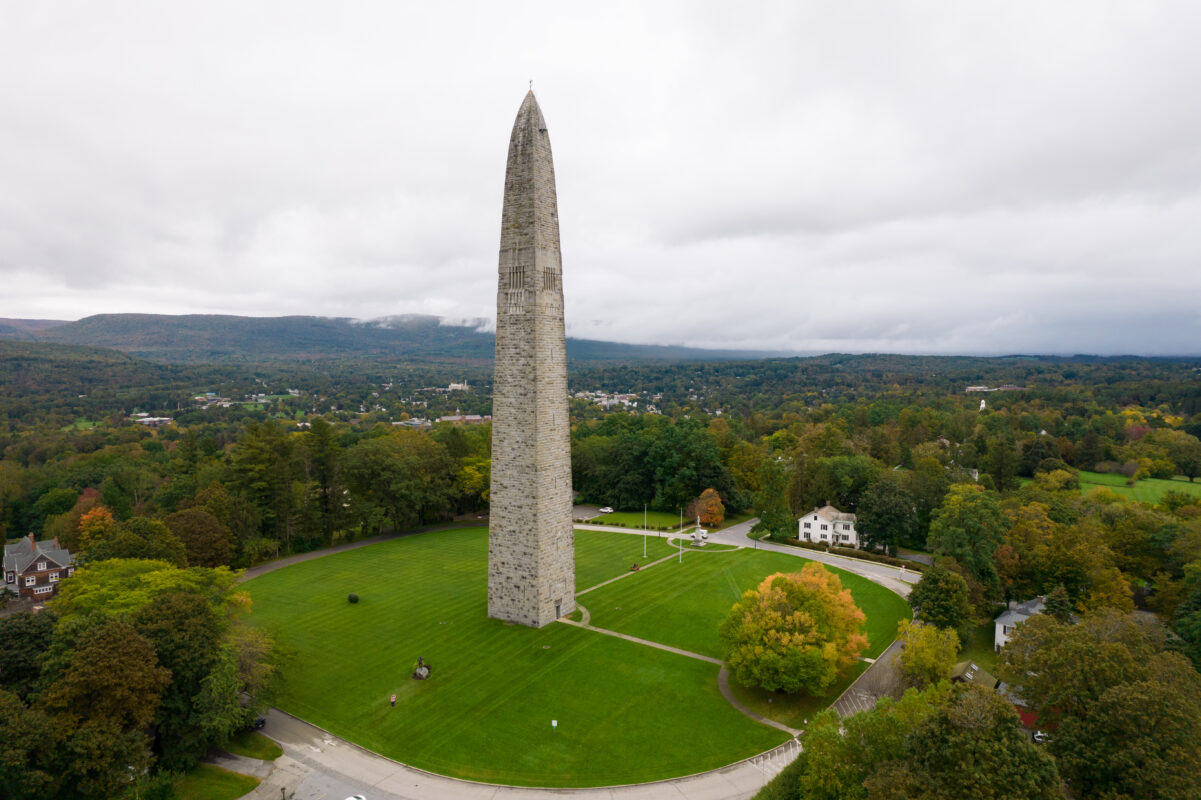
Rising boldly over the Vermont landscape, the Bennington Battle Monument is more than just a striking 306-foot stone obelisk — it’s a testament to a pivotal American Revolutionary War battle, steeped in heroism, patriotism, and unmistakable echoes of the past. Nestled in the charming town of Bennington, this towering landmark is a magnet for history buffs, architecture lovers, and yes, even paranormal enthusiasts. Whether you’re lured by tales of colonial valor or compelled by the whispers of spirits who may still roam the grounds, the monument offers a captivating blend of past and present. Join us as we dive into the gripping history and ghostly lore surrounding the Bennington Battle Monument — and discover why it deserves a spot on every ghost hunter’s must-visit list.
The History
The Revolutionary War and the Battle of Bennington
The Bennington Battle Monument commemorates the Battle of Bennington, a key encounter during the American Revolutionary War. On August 16, 1777, colonial forces commanded by General John Stark clashed with British troops led by General Friedrich Baum. The British, under orders from General John Burgoyne, were on a mission to seize much-needed supplies stored in Bennington, Vermont — but things didn’t go as planned. Stark’s forces, comprised of New Hampshire, Vermont, and Massachusetts militiamen, mounted a decisive attack that resulted in a resounding colonial victory.
The battle was a turning point in the war. Though technically fought in nearby Walloomsac, New York, the supplies and armory the British were after were stored in Bennington, hence the name. The victory significantly weakened Burgoyne’s army and helped lead to his ultimate surrender at Saratoga, a major momentum shift for the American cause. The American win at Bennington emboldened Patriot morale and demonstrated the effectiveness of the militia — ordinary men defending their homes, their families, and their freedom.
Construction of the Monument
It wasn’t until nearly a century after the battle that the idea of a monument began to take root. The Bennington Battle Monument was constructed to honor those who fought and died in the Revolutionary War skirmish — and to educate future generations about this crucial point in American history.
Ground was broken in 1887, and after six years of construction, the monument was officially completed and dedicated in 1891. The design work was done by architect J. Phillip Rinn, and the stone used was blue-gray magnesian limestone from Sandy Hill, New York. Standing at over 300 feet, it’s the tallest human-made structure in Vermont and can be seen from miles around.
Key Features and Interior
Inside the monument, visitors will find a series of exhibits and plaques that describe the events of the battle along with portraits and relics from the Revolutionary War. An elevator ride brings guests to the observatory level, offering sweeping panoramic views of the Vermont countryside, New York’s Taconic Mountains, and Massachusetts to the south. It’s as stunning as it is sobering — a beautiful view layered with echoes of struggle and sacrifice.
Statues of prominent heroes like General John Stark and Seth Warner adorn the grounds, immortalizing the men whose leadership helped secure the pivotal victory. The names of the fallen are remembered, their sacrifice etched not only into stone but into the very soul of this historic ground.
The Haunt
Ghostly Whisperings in Bennington
Though the battle took place over two centuries ago, some believe the spirits of the fallen never left. Visitors and locals alike report strange and chilling occurrences at the Bennington Battle Monument, especially near dusk, when the sun dips low and shadows stretch across the battlefield. For those with a passion for the paranormal, this site is more than a piece of history — it’s a gateway to the unexplained.
Soldier Sightings and Phantom Footsteps
One of the most commonly cited hauntings involves ghostly sightings of Revolutionary War-era soldiers. Tourists and staff have reported seeing the semi-transparent figure of a man in colonial garb silently patrolling the grounds, musket in hand. He often disappears without a trace, leaving behind the faint echo of marching footsteps on the gravel paths.
Inside the tower, others have experienced cold spots — sudden pockets of air significantly colder than the surrounding environment. Some visitors say they hear whispers, unusual creaking sounds, or even the soft hint of distant gunfire. While these could theoretically be explained by wind or old structural elements, seasoned ghost hunters know better. The location has the thick, palpable feeling of history — the kind that imprints onto the very stone itself.
Mysterious Elevator Encounters
The observatory elevator has been the setting of several unsettling episodes. A few visitors have recounted being alone in the lift when it unexpectedly halts midway up or down, followed by a brief moment of eerie silence, and then a strange pressure on the chest — as if someone (or something) is riding alongside them. While no accidents have been officially recorded, maintenance checks show no mechanical deficits, leading some to theorize paranormal interference.
The Bennington Triangle Connection
No mention of haunted Bennington is complete without highlighting the infamous Bennington Triangle — a region shrouded in mystery where multiple unexplained disappearances occurred between the 1940s and 1950s. While the monument lies on the periphery of this area, its proximity to the triangle’s bizarre history adds to its mystique.
Could there be an energetic thread weaving together the monument and the cultural folklore of this allegedly cursed region? Many believe the area sits on some form of energetic fault line, one that may act as a conduit for spiritual activity — making the monument both a historically significant site and a paranormal beacon.
Why Ghost Hunters Should Visit
For ghost hunters and paranormal researchers, the Bennington Battle Monument is a dream destination. Layered with rich Revolutionary War history and wrapped in tales of mysterious encounters, the monument offers a unique blend of educational value and spectral magnetism. It’s a place where past and present blur — and where the dead might still walk among us.
If you bring your EVP recorders, EMF detectors, and thermal cameras, you just might capture something otherworldly. And even if you don’t, the profound weight of historic sacrifice mixed with unexplainable occurrences makes the monument a deeply moving experience.
- Best Time to Visit: Dusk into evening hours for that undeniable feeling of presence — though the tower generally closes at 5 PM.
- Paranormal Tools Suggested: EMF readers, audio recorders, thermal imaging cameras.
- Caution: Be respectful — this is a burial site for many and a reverent memorial for all.
Ready your gear, sharpen your senses, and prepare to honor the past — and possibly make contact with it. The Bennington Battle Monument isn’t just a piece of American history… it’s a whisper from the other side calling out to be heard. Are you willing to listen?
Books Related To This Haunted Location
As an Amazon Associate we earn from qualifying purchases.