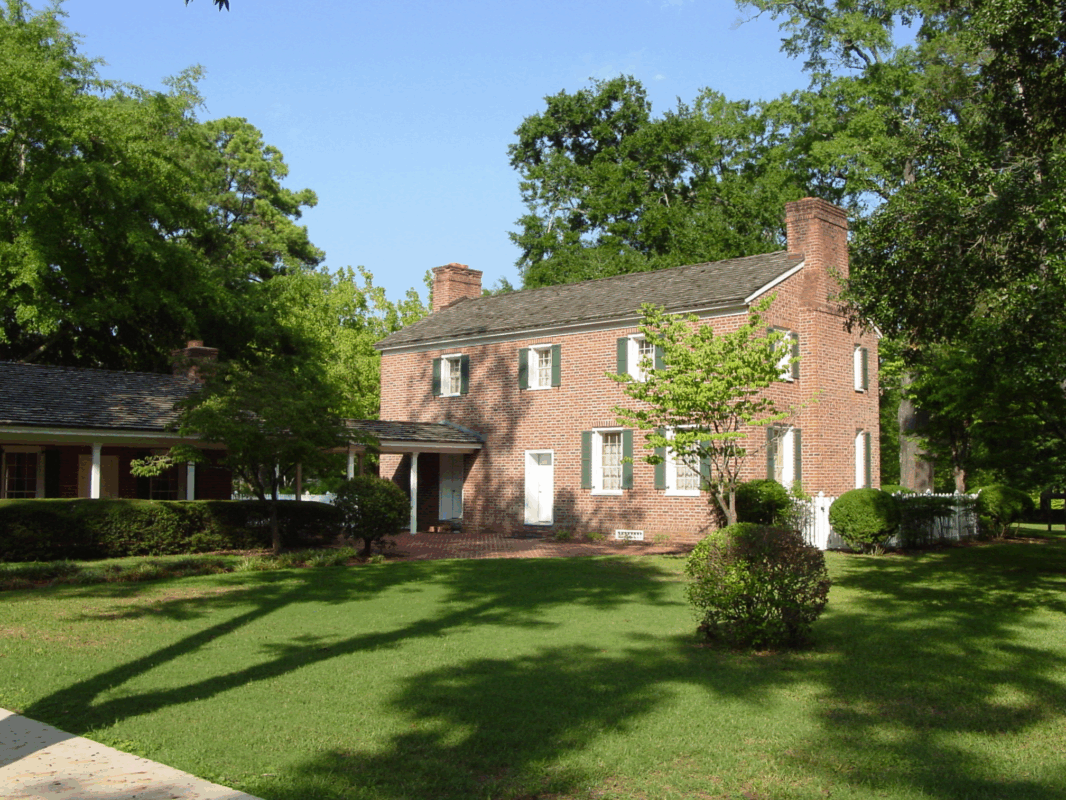
Tucked away in the charming town of Montevallo, Alabama, lies a house steeped in Southern history and eerie energy: the University of Montevallo’s King House. With its Federal-style architecture and picturesque setting, King House is more than just a historic building. It’s a treasured landmark of the University of Montevallo and, by many accounts, one of the most haunted locations in the state of Alabama. Whether you’re a history buff, a student of the paranormal, or simply a curious traveler, this enigmatic destination has a story to tell — one that spans over two centuries. Join us on a captivating journey into the past, and possibly the supernatural, as we explore the haunting legacy of King House.
The History
A Southern Gem Built in Antebellum Splendor
King House, located on the campus of the University of Montevallo, stands as a testament to Alabama’s antebellum heritage. Constructed in 1823, the house was built by Edmund King, a wealthy planter, businessman, and the leading citizen of early Montevallo. Born in Virginia in 1782, King married Nancy Ragan in Georgia in 1812 before heading west in search of new opportunity. In 1817, guided by William Weatherford — the Muscogee Creek leader known as Red Eagle — King and his family settled on the land that would become Montevallo.
As King’s fortune grew through planting, mercantile trade, and railroad promotion, he set about building a home that reflected his rising status. The house was built in the Federal style that was popular across the early American South — a symmetrical, handsome brick structure that was considered one of the finest homes in central Alabama at the time. What truly set King House apart was its construction: the bricks were made from clay cut at nearby Shoal Creek by enslaved laborers, and the house was among the first in the region to feature imported glass window panes. In its day, it was known simply as Mansion House.
It is important to note that King House was built through the forced labor of enslaved people. Between 1823 and King’s death in 1863, he enslaved as many as fifty people at any given time across at least two generations. The men, women, and children who lived and labored on this land are largely unremembered — their burial sites remain unconfirmed, and for much of the university’s history, their stories were not told. Any account of King House’s grandeur must also reckon with this reality.
Legacy of the King Family
Edmund King was more than just a successful businessman. He was a prominent supporter of education and religious causes, donating land for churches, roads, and schools in the Montevallo area. He was a devout Baptist who frequently wrote for The Alabama Baptist on issues of the day. But King’s life was also marked by personal tragedy. His first wife, Nancy, died in 1842. His second wife, Susan Ward King, whom he married in 1848, died just two years later in 1850. One of his sons, Lyttleton, was accidentally shot and killed by another brother during a deer hunting trip. King himself died on June 28, 1863, at the age of 82. All are buried in the King family cemetery, which remains on the university campus behind Harman Hall.
After King’s death, the property passed through other hands. In 1908, the Alabama Girls’ Technical Institute — the forerunner of the University of Montevallo — purchased the house and 43 acres of surrounding land from the Nabors family for $8,502. The institution had been founded in 1896 as the Alabama Girls’ Industrial School (AGIS), a state-supported technical school established through the efforts of reformer Julia Tutwiler and state senator Sol Bloch. Its mission was to train young women in practical, self-supporting skills such as teaching, bookkeeping, dressmaking, and telegraphy. Over the decades, the school evolved — becoming a degree-granting institution in 1923, admitting men beginning in 1956, and officially becoming the University of Montevallo in 1969. Through these transformations, King House served various roles, including as a campus infirmary, a classroom building, and a home economics practice house.
A Living Monument
Today, King House is listed on the National Register of Historic Places and continues to serve as a symbol of Montevallo’s layered past. The house was restored to its original appearance in 1973–1974 with the help of a federal grant, and it is now used for university events, meetings, and preservation education. Twenty-eight structures on the Montevallo campus are listed on the National Register, and the central campus itself is designated a National Historic District, with grounds originally planned by the Olmsted Brothers firm. While many appreciate King House for its historical and architectural significance, others find themselves drawn to it for reasons far more mysterious.
The Haunt
Whispers Between the Walls
Of all the buildings on the University of Montevallo’s historic campus, few stir the imagination quite like King House. For as long as there have been students on this campus, ghost stories have swirled around the old brick house and the family cemetery that lies nearby. These tales have been passed down through generations of students, recounted on campus ghost tours, and investigated by paranormal teams from across the country. The university’s own reference librarian once organized a campus ghost walk specifically to address the sheer volume of questions about the hauntings and to set the historical record straight. King House is widely considered one of the most haunted buildings in Alabama, and its ghost stories are among the oldest and most enduring on campus.
Interestingly, many of the earliest ghost stories associated with King House trace their origins not to students or faculty, but to African Americans formerly enslaved on or near the King plantation. As early as 1913, college students recorded tales from elderly members of the first-freed generation — people known in the college yearbook only by names like Uncle Ben, Uncle Frank, and Aunt Julia — who shared vivid and entertaining ghost stories that are still echoed in campus lore today.
The Spirit of Edmund King
The most commonly reported presence at King House is that of Edmund King himself. According to longstanding legend, King’s deep attachment to his estate and his family has kept his spirit tethered to the property. The most iconic version of the story holds that King buried gold coins in his peach orchard during the Civil War to prevent advancing troops from seizing them, and that his ghost still roams the grounds at night, lantern and shovel in hand, searching for his hidden fortune. (It is worth noting that King actually died in 1863, likely before Union troops arrived in Montevallo, which casts doubt on the buried-gold legend — but the story persists regardless.)
People have reported seeing a dim light and a shadowy figure in the windows of the house’s upper floor — the same bedroom where King spent much of his later years. The figure is sometimes described as opening the curtains and appearing to look out at passersby, occasionally even seeming to smile. These sightings are often accompanied by the sound of slow, deliberate footsteps from within the room, as well as the faint sound of clinking coins — as though someone were counting money. Those who have tried to investigate the sounds report that the noises stop the moment you touch the bedroom door.
Beyond the house itself, spectral bobbing lights have been reported in and around the King family cemetery, where Edmund, his wives, and several of his children are buried.
Mysterious Sounds and Unseen Presences
Reports from university staff and students suggest that King House takes on a distinctly unsettling quality after dark. Footsteps have been heard crossing wooden floors when the building is known to be empty. Doors and windows have reportedly opened on their own, and unexplained fluctuations in temperature — cold spots with no apparent source — have been noted throughout the house.
One account describes a young man peering through the kitchen window of King House from outside when he suddenly felt a hand on his shoulder. Assuming it was his companion trying to get his attention, he turned around — only to find her standing across the brick patio, far out of reach, staring into an upstairs window. Others who have spent time in the kitchen have reported an uneasy feeling — an oppressive sense of being watched that they struggle to explain.
University personnel have described the experience of locking up the house after events, only to hear loud, deliberate footsteps echoing down the hallway from inside. Upon re-entering to investigate, they find the building completely empty with all doors and windows secured.
Paranormal Investigations
While no formal academic studies of the paranormal activity at King House have been published, the building has attracted serious attention from the ghost-hunting community. The university’s former public relations director hosted between twelve and fifteen paranormal investigation teams from across the United States during her years on staff. She noted that one team ran through 138 batteries in a single night, attributing the rapid drain to heightened spiritual activity.
Investigators have brought EMF detectors, thermal cameras, spirit boxes, and audio recording equipment into the house. Many teams have independently arrived at strikingly similar conclusions: that the parlor is the most consistently active area of the house, and that multiple distinct presences may inhabit the building. The consistency of these findings across unrelated teams — many of whom had no prior knowledge of each other’s results — has added to King House’s reputation among paranormal enthusiasts.
Some who have worked at the university for years prefer not to discuss their own experiences at all. As one anonymous staff member put it simply: “I’m sorry. I just can’t talk about it.”
A Place Where History Lingers
The University of Montevallo’s King House is a place where the past feels very close — sometimes uncomfortably so. Its story is one of ambition and tragedy, of wealth built on the backs of enslaved people, of a family cemetery where the dead rest just steps from where students walk to class. Whether or not you believe in ghosts, there is something undeniably compelling about a building that has inspired unbroken storytelling for more than a century — tales that began with formerly enslaved people sharing stories by firelight and continue today with students daring each other to look into darkened windows after sunset.
If you find yourself on the Montevallo campus, it’s worth pausing at King House. Take in the handmade bricks, the old glass panes, the quiet grounds. And if you happen to catch a dim light moving behind an upstairs curtain, or hear the faint clink of coins from a room you know to be empty — well, you won’t be the first.