
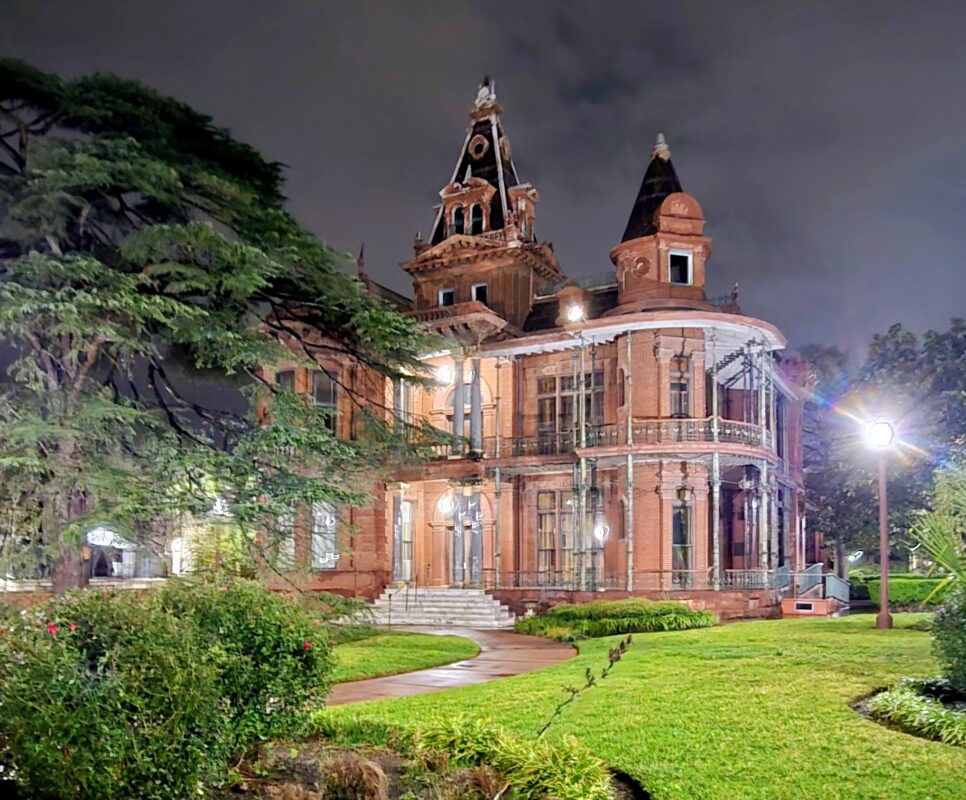
On a shaded corner of the University of Texas at Austin campus, where Whitis Avenue meets 24th Street, sits a turreted red-brick Victorian that does not quite belong to the century surrounding it. Students hurry past it without a glance. Tourists cannot go inside. Even the employees who work there tend to go quiet when you ask them about what happens after the lights go out. This is the Littlefield House, and it has been whispered about in Austin ghost circles for nearly a century.
The History
The house was commissioned in 1893 by Major George Washington Littlefield, a former Confederate officer turned cattle baron and banker, and his wife, Alice Tillar Littlefield. Architect James Wahrenberger designed it in a defiantly ornate Victorian style, with two mismatched towers — one square, one round — rising above a multicolored slate roof. The brick was shipped in from St. Louis, and the mortar was mixed with crushed quartz so that the exterior would actually sparkle in the Texas sun. Inside, the rooms were paneled with tooled leather and several varieties of hand-carved wood, and the staircases were etched with the family’s initials.
Alice was born in Virginia in 1846 and raised in Gonzales, Texas, where she enrolled at Gonzales College at the age of eleven. In addition to the standard curriculum, she studied painting, music, and French. She was sixteen when she married George in Houston in 1863. Their two children — a son and a daughter — both died in infancy, a loss that would quietly shape the rest of their lives together.
By the time the couple settled in Austin in 1883 and built the mansion a decade later, Alice was known across the city less for her husband’s money than for her own quiet influence. She painted. A number of her canvases still hang inside the house today. She played piano. She took visible pride in the gardens, and in a massive deodar cedar that had been shipped, along with a load of its native Himalayan soil, from halfway around the world to be planted on the southwest corner of the lot. The tree is still there today, more than a hundred and thirty years later, and now stands close to sixty feet tall.
Unable to raise children of their own, George and Alice turned the house into something unusual for its era — a home built for dozens of other people’s children. They paid, in full, for the college educations of every one of their twenty-nine nieces and nephews. Many of them lived at the Littlefield House while attending UT, sometimes as many as thirty at a time. One niece would later write that everyone in the family worshipped Aunt Alice, and that she could not have loved her more if Alice had been her own mother.
While George busied himself as a UT regent, bank president, and campus benefactor, Alice built her own quieter portfolio. She organized a local children’s home. She joined civic and preservation groups and traveled as a delegate to national conferences. And, according to her own relatives, she personally originated the idea that would become her most lasting legacy on the campus. Her great-nephew Maurice Hood Dowell remembered her saying that a girl’s first year away from home was lonely without a place to call her own, and that the University ought to build a proper dormitory for freshman women. That dormitory, funded through the Littlefield estate and named in Alice’s honor, was dedicated in 1927. She was the guest of honor. Six years later, in 1933, when the Littlefield Memorial Fountain and nine other campus buildings were dedicated in a single sweeping ceremony, she was again the guest of honor — the common thread running through a growing constellation of buildings now carrying her family’s name.
Somewhere around 1912, something darker began to move through the mansion. Alice, then in her mid-sixties, developed what her doctors described as an unexplained nervous condition. She became convinced that her entire household was going to be murdered and that she herself would be abducted. She would sometimes run down the stairs screaming, until someone caught hold of her. When a physician suggested she be placed in a sanitarium, George refused outright. He hired three full-time nurses instead and kept her at home. The condition persisted for eight years, and then, strangely, lifted almost the moment George died of pneumonia in 1920 — as though the thing she had been terrified of losing was already gone, and there was nothing left to fear.
Alice lived another fifteen years, mostly in the house she loved. In her will, she left the mansion to the University of Texas, honoring a promise she and George had made together. She died at age eighty-eight in January of 1935.
What came next is almost stranger than the ghost stories. The mansion served briefly as a sorority house, then as music practice rooms for the UT School of Music, and — most unexpectedly — as a Naval ROTC headquarters during World War II. Anti-aircraft guns were set up on the front lawn. A firing range was installed in the attic. The bullet holes, according to the University’s own local historian, are still up there. Today the first floor is used for small university functions, and the upstairs rooms are occupied by the Office of University Events. The home is not open to the public. Only authorized personnel are permitted inside. The university politely declines most interview requests about the building, and the staff, when asked, tend to go still and pick their words carefully.
The Haunt
Security guards are the ones who talk. Quietly, usually off the record, but they do talk.
The story that nearly every paranormal researcher in Austin eventually hears concerns a security guard who was the last person out of the building at the end of his shift. He had already set the alarm and reached the bottom step when he heard, unmistakably, somebody walking around upstairs. Wooden floors. Steady pace. He told a local tour operator that the rest of the staff hears it too. Another guard, speaking to a different investigator, mentioned an unofficial rule among the security company that monitors the building: they do not respond to the motion detectors unless more than one is tripping at a time. The reason, as he understood it, is that there is always at least one motion detector somewhere in the Littlefield House going off. Always.
The apparition most often described is a woman in a full, floor-length period dress. She has been seen in an upstairs hallway on the second floor, often near one of the tower rooms. Nobody can ever describe her face. Almost every witness, without prompting, identifies her as Alice.
Her piano is the other signature. The sound of a piano being played on the second floor, late at night when no one is supposed to be in the house, has been reported for decades. A former UT music student who practiced in one of the upstairs studios in the 1960s recalled hearing footsteps and doors closing on empty floors while she played, and was not the least bit frightened — merely intrigued. A tour guide once mentioned that a guest identified the piece drifting down from above on one occasion as Schubert.
Beyond that, the list of reported phenomena reads like a catalog. Objects shift positions between evening and morning. Faces appear in the upper windows to passersby on the sidewalk outside, including the windows of rooms known to be empty. A housekeeper who died in the home is said to still move through certain rooms. There are unexplained running footsteps on the main staircase, and, on a handful of occasions, screams in the middle of the night. A portrait of George Littlefield hanging in one of the hallways has developed its own specific reputation: his left eye, according to nearly everyone who has stood in front of it, follows you as you cross the room.
One of the strangest stories is not a sighting at all. A woman who worked at the mansion came home one evening and was hugged by her young granddaughter. The little girl let go, stepped back, and told her grandmother that she smelled like a ghost.
A longtime Austin paranormal investigator has observed that staff inside the Littlefield House tend to grow less talkative about these phenomena the longer they work there. Her theory is that people eventually come to feel that speaking about it gives it permission to continue, and so they stop. The Littlefield family, for their part, has formally asked the University to stop referencing the haunting on official websites, and the University has complied. The descendants have pushed back especially hard against the attic-imprisonment legend — the story, popular among ghost tour companies, that George locked Alice away upstairs to protect her from imagined Yankee invaders. Family historians say there is no evidence for it, that it is cruel, and that it is contradicted by every surviving letter in the family archive.
And yet.
The woman on the second floor keeps appearing. The piano keeps playing. Motion detectors keep tripping in empty rooms. And the mansion at the corner of Whitis and 24th — built by a couple who could not have their own children and instead filled its rooms with every niece and nephew they could reach — keeps being watched over, according to the people who work inside, by someone who has never quite let it go.