
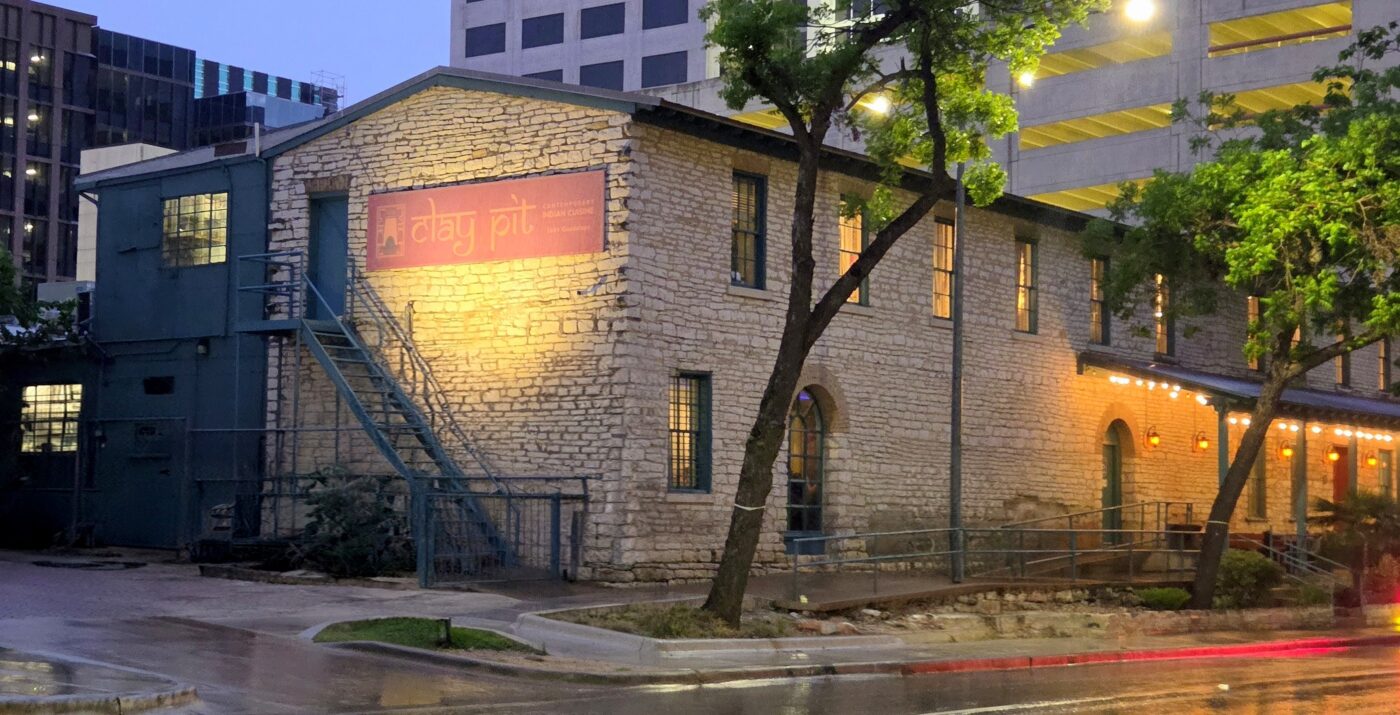
Tucked between the Texas State Capitol and the University of Texas campus, a weathered limestone storefront has stood watch over Guadalupe Street since Austin was still a dusty frontier capital carved out of the wagon roads. Today, The Clay Pit serves some of the most acclaimed contemporary Indian cuisine in the city, drawing diners who come for the butter chicken and tandoor-baked breads. But behind the elegant plating and candlelit dining room lies a much darker menu — one of murdered sex workers, plague-stricken children, sealed-up tunnels, and restless spirits that have never quite checked out. Known just as often by its older name, the Bertram Building, this restaurant is widely regarded as one of the most haunted locations in Austin. Grab your EMF meter and your appetite — we’re stepping into 1601 Guadalupe.
The History
A German Immigrant’s Austin Dream
The story of the Bertram Building begins with Rudolph Bertram, a German immigrant who arrived in Austin in 1853, just over a decade after the city had been named capital of the new Republic of Texas. Drawn by the rapid growth and economic opportunity of the young capital, Bertram initially worked on surrounding ranches, saving every dollar he could. He opened a modest trading post shortly after his arrival — a rough-and-ready outpost where early settlers, soldiers, traders, and displaced Native Americans came to barter for supplies.
Between 1860 and 1862, Bertram purchased the city block at the corner of 16th and Guadalupe, and by 1866 he had erected the limestone structure that still stands there today. At the time, the building sat in an “outlot” in the area informally called “the back of the Capitol,” a suburban edge of Austin largely bypassed by the railroads and dependent instead on wagon-road trade. On that foundation, Bertram built a small empire: a general store, saloon, blacksmith shop, wagon yard, and small hotel that supplied farmers, teamsters, and travelers rolling in from the surrounding countryside. The full wholesale grocery, saloon, and general merchandise operation on the first floor kicked into high gear in 1880.
Bertram became one of Austin’s leading businessmen and civic figures — a city alderman, a director of the First National Bank of Austin, and the largest stockholder in the Austin and Northwestern Railroad. When that railroad pushed west into Burnet County in 1882, Bertram platted a 40-acre town site along its tracks. The nearby community of San Gabriel picked up and relocated two miles northwest to be near the new depot, and the town was named Bertram in his honor. Despite sharing its name, however, Rudolph himself never moved there. He continued to live and work in Austin until the end of his life.
A Building That Grew With the Family
As the Bertram family grew, so did the building itself. The first floor housed the store, saloon, and wholesale operation, while the second floor served as the family’s private living quarters. Early photographs displayed in the restaurant’s Wine Room show an earlier, noticeably smaller Bertram Building that was later enlarged to roughly its current size. A visible seam in the upstairs wall still marks the point where the original structure ended and the addition began.
A Family Marked by Tragedy
Rudolph Bertram married Bertha Marie Charlotte Krohn in 1860, and together they had eight children. Their prosperity was shadowed by devastating loss. Their first child to die was a young son named Carl, who was born in 1864 and passed away in 1866 — the same year the Bertram Building was completed. Over a decade later, the family suffered three more losses in rapid succession. In December 1879, two of their daughters died within just six days of each other. The following October, their ten-year-old son Rudolph, named after his father, succumbed to typhoid fever in an upstairs quarantine room. Local tradition holds that the family moved out of the second-floor residence after the fourth death, unable to bear life in the rooms where they had watched their children die. They remained in Austin, however, and continued to operate the downstairs business.
Rudolph Bertram himself lived until November of 1892. The family is buried together at Oakwood Cemetery just east of downtown — one of Austin’s most famously haunted burial grounds, founded in 1839 and holding some 23,000 souls. The Bertram family plot still contains the graves of Rudolph and Bertha alongside their young children.
The Plow, the Brothel, and the Basement
A weathered iron plow is said to still sit on the roof of the Bertram Building, a trade sign from the store’s earliest days. In the 1800s, when much of Austin’s working population was illiterate, shopkeepers often identified their businesses with symbols rather than words — a boot for a cobbler, a mortar and pestle for an apothecary, a plow for a purveyor of farm supplies and general merchandise. Austin ghost-tour tradition adds a second, knowing layer to the Bertram plow: “plow” had been established slang for sex in English for more than two hundred years by the time the building was raised, and local guides point to the rooftop sign as a discreet signal to a certain kind of customer. Whether the original owners ever intended that meaning is lost to history, but the basement beneath the sign is widely said to have operated in conjunction with the sex trade that filled the blocks around it.
The Guy Town Tunnels
This was no accident of geography. The Bertram Building sat at the northern edge of Austin’s infamous red-light district, officially called the First Ward but universally known as “Guy Town” — at its peak, one of the largest red-light districts in the American Southwest. The neighborhood was dense with brothels, gambling halls, and saloons serving politicians, state legislators, university men, and merchants who didn’t want to be seen walking through the front door.
The solution, legend holds, was a network of underground tunnels — one reportedly running from Bertram’s basement to the State Capitol, and others connecting to the brothels next door. The tunnel to the Capitol is said to have been used during and after construction to discreetly move the state’s gold bullion for secure storage in Bertram’s wine cellar. Other tunnels are rumored to have reached as far as the Driskill Hotel several blocks east — which still houses an original 1890s bank vault from the days when Austin National Bank operated out of the hotel lobby — though whether Bertram’s basement connected directly into that system or was part of a broader downtown network remains a matter of ghost-tour debate. For decades, the city officially denied that any such tunnels ever existed, and entering them has long been illegal. The denial is further complicated by Austin’s bedrock: the city sits on the Edwards Plateau, a thick bed of limestone that makes even a basement a rare and hard-won architectural luxury in this part of Texas, let alone a network of hand-dug passages.
Whatever the full story may be, the tunnel entrances in the Clay Pit’s double-arched cellar are clearly sealed off within the walls. Even today, standing in the basement, you can see exactly where those passages once opened—alongside the hand-stacked limestone blocks laid more than 150 years ago.
From General Store to Indian Fine Dining
The Bertram family’s commercial heyday lasted from the 1870s through the 1890s, transitioning to a more local grocery operation in 1900, and the building went dark and stood vacant from roughly 1914 until the 1940s. Then began a long succession of restaurants: the Old Madrid Cafe in the 1940s, followed by the Old Seville, the Old Toro (a favorite with UT students through the 1950s and ’60s), and the Red Tomato Italian Restaurant beginning in 1977. The Clay Pit took over the space in 1998 and has operated there for more than 25 years. The building was designated an Austin Landmark and added to the National Register of Historic Places in 2012 as a rare surviving example of Austin’s wagon-road commercial era.
The Haunt
The Boy on the Second Floor
The most frequently reported — and most frequently photographed — spirit at The Clay Pit is that of a small boy, widely believed to be the Bertram son who died of typhoid fever in the upstairs quarantine room in October of 1880. Oakwood Cemetery records list his name as Rudolph, the same as his father’s. Staff, patrons, and even neighboring residents across Guadalupe have reported glimpsing a small child’s face peering out of the second-floor windows when no one is supposed to be upstairs. His strongest presence is felt in the back corner room where he was quarantined, still described by visitors as carrying a heavy, mournful atmosphere even on bright afternoons. He is generally described as playful and curious rather than menacing — a child who never stopped playing, even after the house he played in became a restaurant. He is occasionally felt tugging at guests’ clothes on the staircase, reaching up to hold a hand, or peeking around corners before vanishing. A flimsy kitchen door on the second floor has a long-standing habit of wiggling on its own when no one is near it.
The Scarlet Lady
The cellar — with its original limestone walls, double-arched brick supports, and bricked-over tunnel mouths — belongs to a far darker presence. According to the oldest layers of Austin ghost lore, a sex worker was murdered in the building’s basement during the Guy Town era, strangled to death by an unknown client. Because of her profession, her killing was never seriously investigated, and her murderer walked free. She has been known for more than a century as the Scarlet Lady for the red dress she is most often seen wearing, and she remains by far the most active spirit at The Clay Pit.
In the cellar, visitors report sudden drops in temperature, rapidly draining camera and phone batteries, erratic EMF readings, and the unmistakable feeling of being watched. Employees who have taken breaks in the basement have described being awakened from a nap by a woman whispering in their ear, or feeling a breath on the back of their neck and a hand on their shoulder with no one else in the room. Some guests have grown faint, nauseated, or physically unable to keep walking through the cellar, and have had to be helped back up the stairs. Staff have also reported hearing their own names called from the empty stairwell between the cellar and the first floor, and feeling unseen hands brush them or press into their backs near the downstairs bar.
Her presence is not confined to the basement, either. A set of mirrors that once hung more than seven feet off the ground behind the second-floor bar became notorious for catching shadowy figures in their reflections — figures with no corresponding body in the room — and guests occasionally photographed what appeared to be a period-dressed woman staring back out of the glass. The mirrors have since been taken down from the bar and, perhaps fittingly, now sit in storage in the old quarantine room at the back of the second floor. The stories about them have not gone into storage with them.
The Women’s Restroom
The upstairs women’s restroom has developed its own reputation as an unexpectedly active pocket of the building. Guests using the restroom have reported being touched, hearing whispers from empty stalls, watching stall doors swing on their own, and experiencing the sudden, distinct feeling of a second presence pressing in on them when they are alone. It’s unclear whether the activity there belongs to April, to one of the Bertram children, or to an entirely separate spirit — but it is consistent enough that longtime staff and repeat visitors know to mention it.
Phantom Saloon Sounds Upstairs
One of the oldest and most persistent pieces of lore at The Clay Pit involves the ghostly sounds of a saloon in full swing drifting down from the empty second floor. Staff closing down for the night have reported hearing men’s voices, laughter, clinking glasses, and the scrape of chairs — all coming from upstairs when no one is there. The phenomenon follows a strange pattern: the moment a staff member climbs the stairs to investigate, the noises stop cold. Walk back down, and the phantom party starts right back up.
Two Halves of One Haunting
What becomes striking, in the accumulated stories of staff and guests over the decades, is how cleanly the building’s hauntings split along its architecture. The upstairs activity is almost uniformly described as playful, curious, even affectionate — children tugging at sleeves, hide-and-seek in the mirrors, a small boy peeking out of doorways. The downstairs and cellar activity, by contrast, is heavy, oppressive, sometimes physically aggressive — rocks thrown at bartenders, hands pressed into the backs of employees, whispered names in the dark, a suffocating sense of being watched. Whatever lingers in the Bertram Building, the living and the dead here seem to have divided the house between them.
On Paranormal Television
The Clay Pit’s haunted reputation reached a wider audience in October 2015, when the restaurant was featured as the Season 2 premiere of the paranormal investigation series Strange Town, which aired on Austin’s PBS affiliate KLRU-Q. The episode documented first-hand accounts from staff about the child on the second floor, the woman in the cellar, and the phantom saloon sounds, and marked the first full-scale paranormal television investigation ever conducted inside the Bertram Building. Local news crews and independent investigators have returned many times since, with several capturing their own unexplained audio, photographic, and EMF anomalies on camera.
Worth the Risk
The Clay Pit offers a rare kind of Austin experience — one where award-winning cuisine is served in a dining room that’s genuinely older than most of the state around it. Whether you come for the curries, the history, or the ghosts, the Bertram Building doesn’t let you leave without a story. Ask for a table upstairs if you’re feeling brave, linger by the cellar stairs on your way out, and keep an eye on the second-floor windows as you walk away down Guadalupe. Something — or someone — might just be watching you back.