
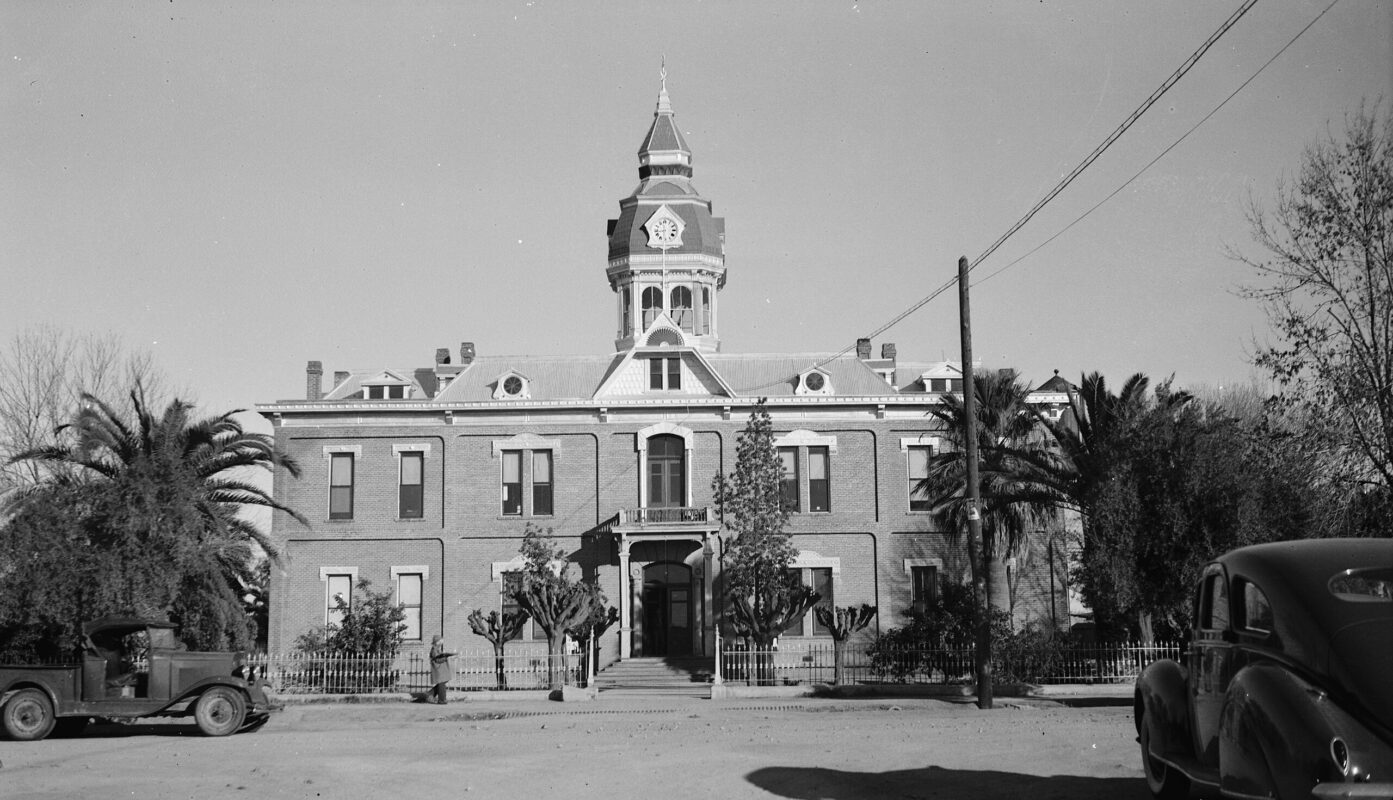
Amid Arizona’s sunbaked deserts and historic towns lies a monument to the territorial past of the American Southwest—the Pinal County Courthouse. Located in Florence, Arizona, this grand building isn’t just a relic of pioneer justice; it’s also a magnet for stories of spirits and the supernatural. Whether you’re a history buff or a ghost hunter looking for your next otherworldly destination, this courthouse combines architecture, mystery, and echoes from a forgotten era in a way few places can. So grab your camera, your EMF detector, and a thirst for adventure—because the Pinal County Courthouse might have more than legal proceedings hidden within its walls.
The History
From Territorial Justice to Early Arizona Government
The Pinal County Courthouse was completed on February 2, 1891, and remains one of the most historically significant buildings in Arizona. Located in Florence, the county seat of Pinal County, the courthouse served as the beating heart of local government during a transformational period in Arizona’s history. Constructed when Arizona was still a territory (it wouldn’t become a state until 1912), this courthouse was an early symbol of law, order, and civic pride in the rugged desert landscape.
The building was designed by prominent Arizona architect James M. Creighton in the Late Victorian Revival style—sometimes also described as American-Victorian. Totaling 15,000 square feet, the redbrick courthouse featured offices for the Supervisors, the Recorder, the Treasurer, and the Assessor, while the Sheriff’s Office and jail occupied the back end of the first floor. Its ornate clock tower became the defining feature of the Florence skyline, though the reality behind it is more charming than imposing: funds ran short during construction, and the county could never afford to install actual clockworks. Instead, clock faces were simply painted onto the tower with the hands permanently set at 11:44—a detail that remains to this day.
Over the years, the courthouse oversaw everything from land disputes to criminal proceedings. One notable early case involved Pearl Hart, jailed in the courthouse in 1899 for robbing a stagecoach. Perhaps most infamously, the courthouse was the site of the sanity hearing for Eva Dugan in 1930. Dugan, convicted of murdering her employer, a Tucson-area rancher, was deemed sane by a jury at the courthouse and subsequently put to death by hanging at the nearby Arizona State Prison. The execution went horribly wrong—Dugan was accidentally decapitated, and the gruesome scene caused several witnesses to faint. She remains the only woman ever executed by the state of Arizona, and the botched hanging led Arizona to replace hanging with the gas chamber as its method of execution.
A Reflection of Florence’s Golden Era
In the late 1800s and early 1900s, Florence prospered as an important settlement in the American West. With the courthouse as its centerpiece, the town grew into one of Arizona’s key government hubs. The courthouse wasn’t just for court hearings—it also housed multiple county offices and served as the operational center of Pinal County governance.
Visitors today can still see remnants of the building’s rougher past. The main floor meeting room where the Pinal County Board of Supervisors now holds public sessions was once the jail, and interior windows along the walls still feature the original iron bars—preserved as a nod to history. With such a long and turbulent history, small wonder the courthouse holds secrets that go well beyond the historical record books.
A Registered Historic Place
On August 2, 1978, the Pinal County Courthouse was added to the National Register of Historic Places, granting it official recognition as a historical treasure. The building continued to serve county functions even after a third courthouse was built in 1961, and it remained in use until it was closed in 2005 due to disrepair. In 2007, it was declared one of the most endangered historic buildings in Arizona.
A major $6 million renovation was completed in December 2012, restoring the courthouse and ridding it of asbestos and outdated wiring. Today, the building is an active county government facility, housing the Pinal County Board of Supervisors, the Clerk of the Board, the Budget Department, and several other county offices. The restored building also hosts special events and community gatherings, including weddings in the former courtroom on the second floor. But some believe that not all who entered these hallowed halls have left.
The Haunt
A Legacy of Justice… and Spirits
From the moment it opened, the Pinal County Courthouse seemed destined to wear two faces: one of solemn order and another of lingering unrest. While it has officially served the law for over 130 years, a number of visitors and employees over the decades have reported experiences they can’t easily explain.
The Heavy Presence of the Old Jail
The top floor of the courthouse once served as a jailhouse, and it is here that many visitors report feeling a strange, oppressive heaviness—as though the weight of the building’s past presses down on anyone who lingers. Some describe the sensation as being watched, while others have noted sudden cold spots in otherwise warm rooms. The feeling is persistent enough that it has been noted independently by multiple people unfamiliar with the building’s history.
The Headless Apparition
Perhaps the most striking recurring claim involves a headless apparition reportedly seen by security officers and others inside the courthouse. According to accounts collected by paranormal researchers, the figure appears to be dressed in the attire of a judge from the 1930s era. Given the building’s association with the macabre decapitation of Eva Dugan—whose sanity hearing was held in this very courthouse—some have drawn a connection, though the reported figure is described as male. The apparition has been seen by multiple witnesses over the years and remains the courthouse’s most well-known ghost story.
Voices, Doors, and Tobacco Smoke
Employees working in the Division 2 judges’ chambers have reported a recurring and distinctive phenomenon: the smell of lingering tobacco smoke in areas where no one has been smoking. The scent appears and vanishes without explanation and has been noted by multiple staff members over time.
Security officers working overnight shifts have also reported hearing disembodied voices echoing through the empty halls, as well as the sound of doors slamming when no one else is in the building. These reports have been consistent enough across different individuals and time periods to earn the courthouse a place on several paranormal location databases.
An Atmosphere That Lingers
While the Pinal County Courthouse hasn’t produced the dramatic, headline-grabbing paranormal evidence seen at some other locations, what it does offer is a persistent, quiet unease reported by people who work in and visit the building. The experiences tend to be subtle—unexplained sounds, phantom smells, fleeting shadows, and an unmistakable sense that the building remembers more than its walls should. For those attuned to such things, the courthouse carries an energy that suggests not everyone who passed through its doors ever truly left.
Where History Refuses to Rest
The Pinal County Courthouse isn’t just a stop on a tour; it’s a destination layered with historic resonance and quiet, persistent mystery. From its striking Late Victorian architecture and its painted-on clock faces to the unsettling stories shared by those who work within its walls, the courthouse offers something memorable for anyone willing to look a little deeper.
Whether you’re a seasoned paranormal investigator or simply someone drawn to places where history feels unusually alive, this location belongs on your Arizona travel list. The rich history of frontier justice, combined with decades of unexplained firsthand accounts, make it one of the most intriguing courthouses in the American Southwest.
So plan a visit to Florence—explore the restored halls, admire the ironwork remnants of the old jail, and take a moment on the upper floors where visitors say the air feels just a little heavier than it should. But remember: justice in Pinal County wasn’t always swift, and some spirits, it seems, are still waiting.