
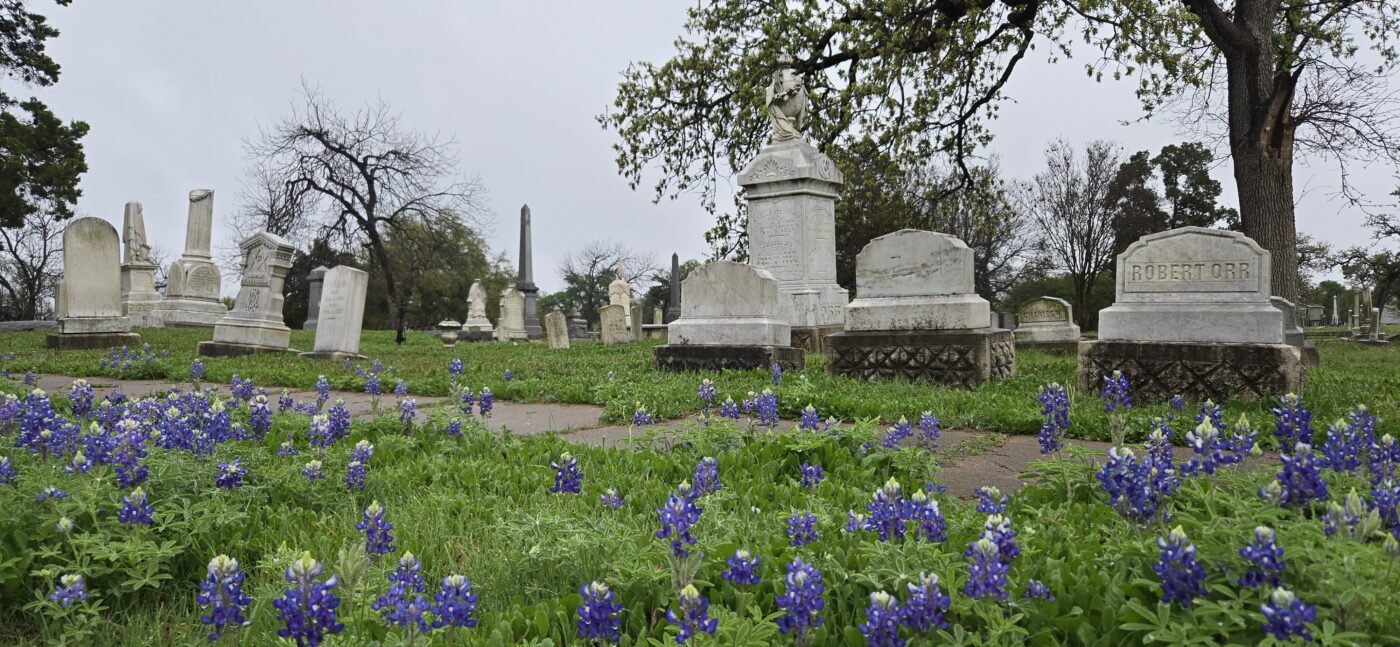
At the eastern edge of downtown Austin, where Navasota Street meets a low rise of oak-shaded ground, the city’s oldest public cemetery keeps its long watch over the living. Oakwood Cemetery has been receiving the dead since 1839 — before Texas was a state, before Austin was fully a city — and in the century and a half since, it has accumulated not only graves but stories, grief, and a persistent sense that some of its residents have never quite left.
The History
Austin itself was barely an idea when Oakwood was established. Mirabeau Lamar had just succeeded Sam Houston as president of the Republic of Texas, and the new capital city on the Colorado River was being carved out of cedar and limestone as fast as men could work. The city cemetery — what would eventually become Oakwood — was set aside in 1839 on the eastern edge of the young townsite, a practical necessity for a frontier settlement that was already burying its dead from disease, violence, and the ordinary hazards of life on the Texas frontier.
For its first several decades, the cemetery operated without formal organization, a common arrangement in frontier towns where land was cheap and record-keeping was inconsistent. Graves went in as needed. Families buried their own. The city’s poor, its transients, and those with no one to speak for them were interred in sections that were not always carefully mapped or marked. By the time the City of Austin formally took over management in the late nineteenth century, portions of the older ground had already become a puzzle of unmarked plots and faded wooden markers.
The People in the Ground
What makes Oakwood remarkable is not just its age but the density of Texas history compressed into its seventeen acres. The cemetery holds the remains of several governors of Texas, including James Stephen Hogg, the first native-born governor of the state, who served from 1891 to 1895 and built a legacy as a trust-busting populist in an era when railroad monopolies strangled Texas commerce. Hogg died in 1906 and was buried at Oakwood with the kind of public mourning that marked the passing of a man who had genuinely changed the shape of his state.
Also buried here is Benjamin McCulloch, a Texas Ranger, a veteran of the Mexican-American War, and a Confederate general who was killed at the Battle of Pea Ridge in March 1862. McCulloch was one of the most celebrated military figures in antebellum Texas, a man whose reputation for ferocity and competence made him a legend before the Civil War finished him. His grave at Oakwood drew visitors for generations.
The cemetery also holds the remains of Edward Burleson, who served as vice president of the Republic of Texas and as a general in the Texas army during the revolution against Mexico. Burleson fought at the Battle of San Jacinto in 1836 alongside Sam Houston, and his grave at Oakwood connects the cemetery directly to the founding mythology of the state.
Mirabeau Lamar himself — the second president of the Republic of Texas, the man who chose Austin as the capital, the poet-politician who envisioned Texas as an empire stretching to the Pacific — was originally buried elsewhere but his legacy saturates the city he built, and Oakwood holds many of the men and women who built it alongside him.
Segregation and the Divided Ground
Like nearly every public institution in the nineteenth and early twentieth century South, Oakwood was segregated. African American Austinites were buried in a separate section of the cemetery, a division that reflected the brutal social architecture of the era. That section, sometimes called Oakwood’s East Addition, holds the graves of formerly enslaved people, of freedmen and freedwomen who built lives in Austin after emancipation, of Black community leaders, educators, and laborers whose contributions to the city were systematically minimized in the historical record.
Among those buried in the segregated section is Manda Sherrill, believed to be among the oldest residents of Austin at the time of her death in the early twentieth century, and said to have been born into slavery. Her grave, and hundreds like it in that section, represents a layer of Austin history that has received far less preservation attention than the ornate monuments in the cemetery’s older white sections. Many markers in the East Addition have been lost to time, weathering, or simple neglect, leaving gaps in the historical record that researchers and community historians have spent years trying to close.
The physical condition of Oakwood has been a recurring civic concern. By the mid-twentieth century, portions of the cemetery had fallen into serious disrepair — overgrown, vandalized, with damaged monuments and sunken graves. The City of Austin and various preservation groups have undertaken restoration efforts over the decades, stabilizing monuments, regrading ground, and attempting to document the unmarked graves that may number in the hundreds. The work is ongoing, and the cemetery today is maintained as an active historic site, though the passage of time has left its marks on even the most prominent graves.
The Potter’s Field
One of the most historically significant and least visited sections of Oakwood is its potter’s field — the ground set aside for Austin’s indigent dead, its unclaimed bodies, its executed criminals, and those who died in the county jail or the state institutions that once dotted the city. The potter’s field received its first burials in the mid-nineteenth century and continued to fill through the early twentieth. The people buried there were often interred without markers, their names recorded only in ledgers that have not always survived. Some were executed by the state of Texas. Some were patients from the Texas State Lunatic Asylum, which opened in Austin in 1857 and sent its unclaimed dead to Oakwood for generations.
The asylum — later renamed the Austin State Hospital — was one of the first institutions of its kind in Texas, and its history is its own complicated story of reform, overcrowding, and the treatment of mental illness in an era that understood very little about it. The patients who ended up in Oakwood’s potter’s field were among the most invisible people in nineteenth-century Texas society, and their presence beneath that quiet ground is a reminder of how much history a cemetery holds that never makes it into the official record.
The Haunt
Oakwood has been considered haunted for as long as anyone in Austin can remember. That is not unusual for a cemetery of its age and history, but what distinguishes Oakwood’s paranormal reputation is the specificity of what people report — not vague unease, but particular figures, particular locations, particular sounds that have been described consistently by people who did not know each other and had no reason to compare notes.
The Woman in the East Section
The most frequently reported apparition at Oakwood is a woman seen moving through the older sections of the cemetery, particularly in the area near the more weathered and crowded graves toward the eastern portion of the grounds. Witnesses have described her as wearing clothing that appears to be from the late nineteenth or early twentieth century — a long dark dress, her hair pinned up in a style that no one wears anymore. She does not appear to be aware of observers. She moves with purpose, as if she is looking for something or someone, and she disappears when approached or when witnesses look away and look back.
Who she might be is a matter of speculation. Some longtime observers of Austin’s paranormal landscape have suggested she may be connected to one of the many women buried in the cemetery who outlived their families and died without survivors to tend their graves. Others have proposed she may be associated with the grief that saturates the older sections of the cemetery, where so many died young — from yellow fever, from tuberculosis, from the ordinary violence of frontier life — and were mourned by people who are themselves long dead.
The Potter’s Field Phenomena
The potter’s field section generates its own distinct category of reports. Visitors and staff members have described a persistent feeling of being watched in that area, a sensation that is reported even by people who did not know the section’s history before visiting. Some have described hearing sounds that do not have an obvious source — a low murmur, something that resembles distressed breathing, sounds that stop abruptly when attention is paid to them.
A longtime local paranormal investigator who has spent years documenting Austin’s haunted sites has noted that the potter’s field consistently produces anomalous readings on electromagnetic field equipment, though what that means in terms of paranormal activity is, as always, a matter of interpretation. What is harder to dismiss is the consistency of the emotional response that section produces in people who have no prior knowledge of what is buried there. The weight of anonymous death, it seems, does not entirely dissipate.
There are also accounts, repeated across years and across different witnesses, of cold spots that move through the potter’s field in patterns that do not correspond to the wind or shade. Staff members who work the grounds have described encountering these pockets of cold air on warm afternoons, localized enough that stepping two feet in any direction removes you from them entirely.
The Monuments After Dark
Several of Oakwood’s more elaborate nineteenth-century monuments — the tall obelisks, the carved angels, the stone urns that mark the graves of Austin’s founding families — have generated their own reports. Visitors who have entered the cemetery near dusk, or who have lingered near closing time, have described seeing figures standing near or leaning against these monuments that, when approached, are not there. The figures are not always described as threatening or even particularly active. They simply stand, the way a person might stand at a grave they visit regularly, and then they are gone.
One particular monument near the grave of a prominent nineteenth-century Austin family has been the subject of repeated reports over several decades. Witnesses describe a figure — male, they generally say, tall, wearing what appears to be a dark coat — standing with his back to observers, facing the grave marker. He has never been reported to turn around. He simply stands until he does not. Whether this figure represents one of the family members buried there, or someone who mourned them, or something else entirely, is not something any amount of investigation has resolved.
The cemetery has attracted paranormal investigation groups for years, and several have documented what they describe as significant activity — EVP recordings that appear to contain voices, photographs with anomalies near specific graves, temperature fluctuations that equipment registers but cannot explain. None of this constitutes proof of anything, and serious investigators are the first to say so. What they tend to agree on is that Oakwood produces more consistent and more specific phenomena than most locations of its type, and that the activity does not seem randomly distributed across the grounds but concentrated in the older sections, the potter’s field, and the areas around the most historically significant graves.
The Sounds at Night
Several accounts from people who live near the cemetery — in the East Austin neighborhood that has grown up around it over the decades — describe sounds coming from the grounds at night that they cannot attribute to animals or wind or the ordinary acoustic oddities of an urban environment. A sound like footsteps on gravel when there is no gravel path near where the sound originates. A sound like a door closing, though there is no door. Occasionally, something that witnesses describe as a voice, speaking at a register too low to make out words, coming from the direction of the older sections of the cemetery on still nights.
These accounts are, of course, impossible to verify. Neighbors have their own explanations — sound traveling strangely from nearby streets, animals moving through the grounds, the ordinary creaks and settlings of old stone. But the accounts persist, and they have persisted for long enough that they have become part of the neighborhood’s understanding of the place at its edge.
Oakwood is open to the public during daylight hours, and the City of Austin maintains it as both an active cemetery and a historic site. It is the kind of place that rewards slow attention — the kind of reading that comes from tracing names on old stones, from noticing the dates that cluster around epidemic years, from understanding that the ground you are walking on holds not just the famous dead but the forgotten ones, the anonymous ones, the ones whose names are gone and whose stories were never written down. Whether or not anything moves through those old oaks after the gates close is a question each visitor will answer for themselves. The history alone is enough to make the ground feel inhabited.