Located at the edge of the Gulf Coast in Alabama, Fort Morgan is more than just a historic military bastion—it’s a stone sentinel that whispers tales from centuries past. With its brick archways, tunnel-like corridors, and commanding views of Mobile Bay, Fort Morgan evokes the mystery of forgotten battles and the lingering presence of those who never left. Whether you’re a history buff, a curious traveler, or a dedicated ghost hunter, Fort Morgan offers an atmospheric blend of rich heritage and eerie legend that is hard to resist. This isn’t just a place to learn about American history—it’s a place to feel it.
The History
Foundations of Fort Morgan
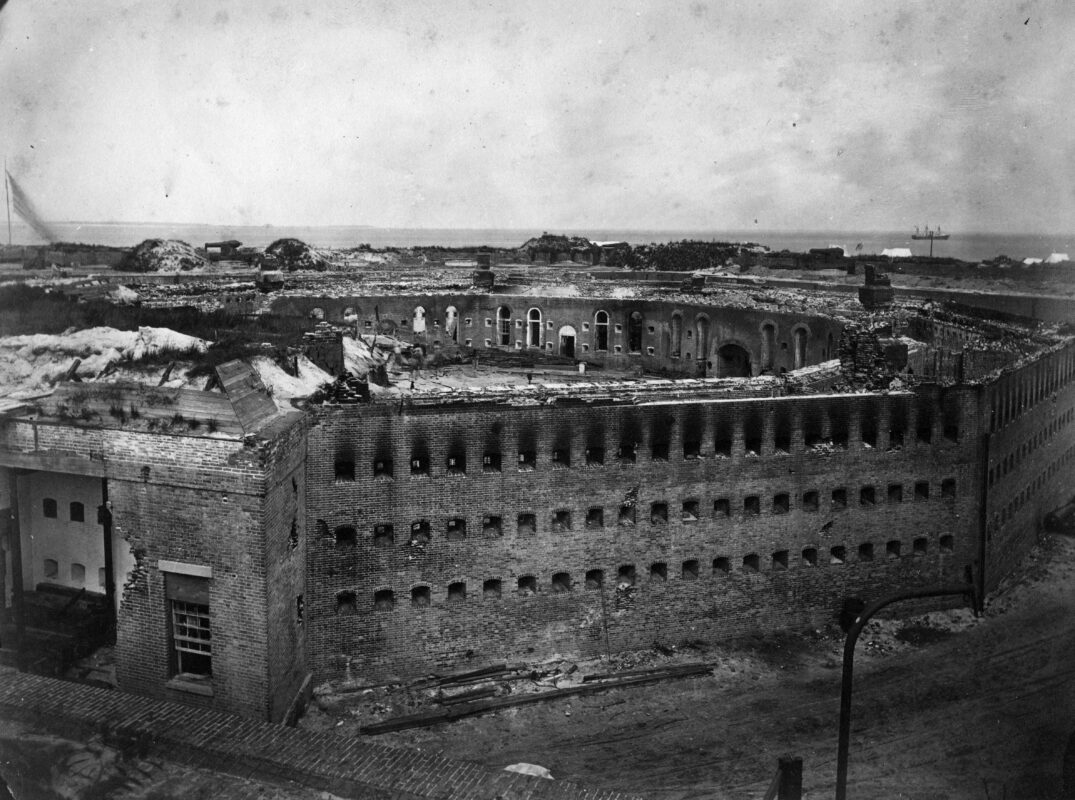
Following the War of 1812, when America’s vulnerability to naval attack became painfully clear, the United States began an ambitious program to strengthen its seacoast defenses. As part of this effort, construction of a large masonry fort on Mobile Point began in 1819. The project was plagued by difficulties from the start—the original contractor died in a yellow fever epidemic, and his successor also died before completing any meaningful work. The U.S. Army Corps of Engineers eventually took over the project, relying heavily on the labor of enslaved African Americans to build the massive fortification, which contains more than 46 million cubic yards of brick. Due to its isolated location and the challenge of shipping materials like granite, sandstone, ironwork, and cement by water from New York, the fort was not completed until 1834. Formally named Fort Morgan in 1833 in honor of Revolutionary War hero General Daniel Morgan, its pentagonal, five-bastioned star shape—designed by Simon Bernard, a former military engineer for Napoleon—represented some of the finest military architecture of the era.
The fort’s location at Mobile Point, where Mobile Bay meets the Gulf of Mexico, made it a strategic linchpin for commerce and coastal defense for over a century.
Fort Morgan in the Civil War
On January 5, 1861, anticipating Alabama’s imminent secession from the Union, state militia seized Fort Morgan in a surprise pre-dawn action and turned it over to the Confederate Army. The fort became the first line of defense for the city of Mobile and provided critical protection for blockade runners entering the bay.
In 1864, Fort Morgan became the focal point of the famous Battle of Mobile Bay. On August 5, Union Admiral David Farragut led his fleet past the fort’s guns and into the heavily mined bay, uttering what would become one of the most iconic commands in American military history: “Damn the torpedoes, full speed ahead!” After the naval battle, the fort’s defenders endured a grueling two-week siege by Union forces before the garrison of approximately 581 men was forced to surrender on August 23, 1864. The fall of Fort Morgan marked a significant Union victory and tightened the Northern blockade of the South.
From Obsolescence to Landmark
The Civil War itself had demonstrated that rifled artillery and steam-powered warships could overpower masonry forts like Morgan. Still, the fort was not abandoned. Between 1895 and 1904, the U.S. Army Corps of Engineers constructed five modern reinforced concrete gun batteries at the site, housing 19 guns and mortars as part of recommendations from the Endicott Board. These batteries were manned during the Spanish-American War—a conflict the fort’s role in is often overlooked—and again during World War I, when some 2,000 troops were stationed there for training.
By 1923, however, the War Department declared Fort Morgan obsolete, and in 1927, it was sold to the state of Alabama for use as a state park. The fort was briefly reactivated during World War II to counter the German U-boat threat in the Gulf of Mexico, with the Army reoccupying the post in 1942 and constructing an adjacent airfield. After the war, the military returned the old fort to the state for the final time, ending its long career in America’s coastal defense.
Fort Morgan was designated a U.S. National Historic Landmark in 1960. It stands today as part of the Fort Morgan State Historic Site—a testament not only to military architecture and sacrifice, but also to the complicated, layered stories of all who lived and died within its walls.
The Haunt
Echoes That Won’t Fade
Fort Morgan’s long history of conflict, disease, and death has given rise to a deep tradition of ghost stories stretching back decades. Visitors, staff, and paranormal investigators have reported a wide range of unexplained phenomena within the fort’s walls, and the site is widely regarded as one of the most haunted locations in Alabama. The fort’s haunted reputation has even drawn television attention—it was featured on the Discovery Channel’s Expedition X, Season 4, Episode 5, titled “Ghost Fort of the Civil War.”
The Old Barracks
Multiple sources consistently identify the old barracks as one of the most active paranormal areas in the fort. In 1917, a prisoner reportedly hanged himself inside the barracks. Since then, visitors have claimed to hear the sound of a man crying during late-night hours. People have also reported being touched by unseen hands and hearing unexplained footsteps in and around the barracks area.
The Civil War Dead
During the Civil War, a bomb reportedly detonated inside one of the fort’s rooms, killing several men. Visitors have reported hearing what sounds like men screaming at night in the vicinity of that event, as though the moment has been imprinted on the fort itself.
Soldiers in the Shadows
Throughout the fort, visitors have reported seeing apparitions of figures in military uniforms—sometimes standing along the battlements, sometimes glimpsed briefly in darkened casemates before vanishing. Shadow figures, strange mists, and the sounds of boots marching through empty corridors are among the most commonly described experiences. Some visitors have also reported capturing unexplained figures in photographs, including what appeared to be a soldier leaning over one of the ground-level cannons.
The Mysterious Woman
Perhaps the most widely known ghost at Fort Morgan is that of a young woman. According to local legend, she was attacked somewhere in or near the fort during the 19th century and died as a result. She is said to still roam the fort and its grounds, searching for her attacker. Multiple sources describe this apparition as one of the most frequently witnessed manifestations at the site.
The Tunnels
The fort’s dark, narrow connecting tunnels are notorious among visitors for sudden temperature drops, feelings of unease, and unsettling sounds—whispers, moans, and distant cries with no identifiable source. These passages are consistently cited as one of the eeriest areas of the fort.
Other Reported Phenomena
Beyond the more well-known stories, visitors have described a range of other experiences: strange lights in the night sky above the fort, a sudden and overwhelming feeling of dread, unusual readings on EMF meters and thermal equipment, disembodied voices, and the distant sound of cannon fire—a spectral echo of the Battle of Mobile Bay.
Walk the Corridors
Whether you come armed with a history textbook or a spirit box, Fort Morgan is an essential stop along Alabama’s haunted landscape. Each October, the site typically hosts special haunted tours and evening events where storytellers and historians bring its ghostly past to life—but even on an ordinary visit, the weight of the fort’s history is impossible to ignore. The brick archways, the dim tunnels, the wind off Mobile Bay—it all conspires to make you feel as though you are not entirely alone.
Fort Morgan is located at the far western end of Fort Morgan Road (Highway 180) in Gulf Shores, Alabama, and is open daily for public visitation. If you go, keep your eyes open and your camera ready. According to generations of visitors, the spirits of Fort Morgan are still very much on duty.