Down a dirt road off County Road 473, just east of the tiny Coffee County town of Kinston, Alabama, sits one of the most storied haunted locations in the state — Harrison Cemetery. Home to the famous above-ground tomb of William “Grancer” Harrison, this quiet burial ground among the pines has been drawing the curious, the skeptical, and the brave for well over a century. The legend of Grancer Harrison — a wealthy cotton planter who loved dancing so much he insisted on being buried in his clogging shoes — was immortalized in Kathryn Tucker Windham’s beloved 1969 book 13 Alabama Ghosts and Jeffrey and has since become one of Alabama’s most enduring ghost stories. In 2021, the Alabama Folklife Association and the William G. Pomeroy Foundation erected an official historical marker at the site acknowledging the legend. Whether you’re a history enthusiast, a student of Southern folklore, or a paranormal investigator hoping to hear a phantom fiddle on a Saturday night, Harrison Cemetery is a compelling piece of Alabama’s haunted heritage.
The History
The Man Behind the Legend
Harrison Cemetery takes its name from the Harrison family, early settlers to Coffee County. The central figure of the cemetery’s history — and its ghost story — is William “Grancer” Harrison. Born around 1789 in the old Ninety-Six District of Edgefield County, South Carolina, Harrison made his way to Alabama sometime in the 1830s, where he established a sprawling cotton plantation of roughly 2,500 acres near the junction of Cripple Creek and the Pea River, just outside of what is now Kinston. The plantation sat on a high bank overlooking the Pea River, and Harrison is said to have been the largest slaveholder in the county.
His nickname, “Grancer,” was not a local invention but a term rooted in his South Carolina origins. Common among immigrants from Western Britain who settled in the Carolinas, “Grancer” was an affectionate shortening of “Grand Sire” — meaning grandfather — likely given to him by his many children and grandchildren. Harrison and his wife, Nancy Justice Harrison, had at least ten children together.
But Grancer was known for more than farming. He was famous throughout the region for his hospitality and his love of a good time. He hosted barbecues, horse races, and dances as often as he could — by most accounts on Saturday nights, though some sources say Thursdays. He loved these gatherings so much that he had his enslaved workers build a large dance hall on the property expressly for the purpose. At these legendary parties, Grancer would play his fiddle and dance long into the night in a special pair of custom-made clogs.
Buried for the Dance
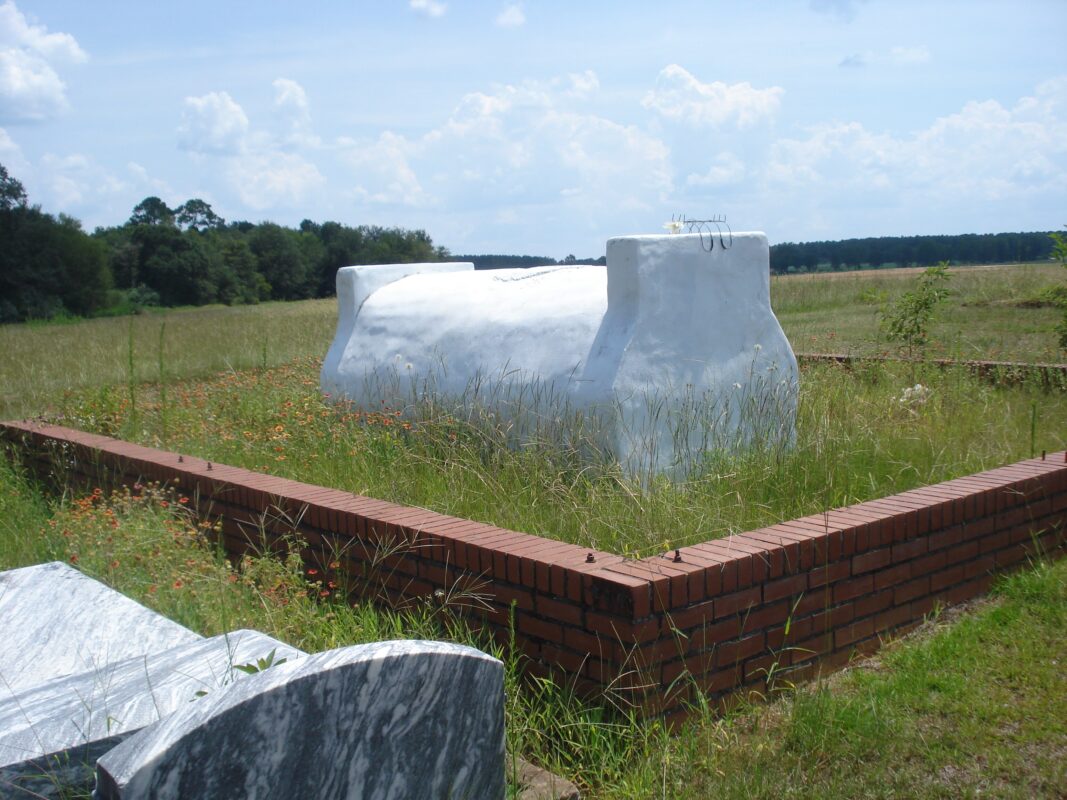
As Harrison aged, he confronted his mortality with the same flair he brought to everything else. He ordered his enslaved workers to travel to a brick kiln in Milton, Florida, and return with loads of brick. From these, they constructed a large above-ground tomb within earshot of the dance hall. Grancer’s burial instructions were precise and eccentric: he was to be laid to rest on his feather bed, dressed in his finest dancing clothes, wearing his beloved clogging shoes. Some versions of the story add that his fiddle was placed in his hands.
When Harrison died in 1860, his wishes were carried out exactly. The Saturday night dances continued for a time after his passing, but without Grancer’s spirited presence, the gatherings lost their spark. The dance hall eventually fell into ruin. Neither the hall nor Harrison’s original home survives today.
A Cemetery Scarred by Time
Harrison Cemetery holds approximately 159 burial sites. Among those interred is Harrison’s father, William Harrison Sr., believed to be the only known Revolutionary War patriot buried in Coffee County. The cemetery began as a family plot but expanded over time to include members of the surrounding community. In addition to marked graves, unmarked plots are believed to exist on the grounds, some suspected to contain the remains of enslaved individuals. Members of the Harrison family have recalled seeing numbered metal markers in the rear of the cemetery that once designated slave graves.
The cemetery has suffered through periods of neglect and serious vandalism. Rumors persisted for decades that Grancer had been buried with a fortune in gold, or that gold was hidden near the old dance hall. In 1964, vandals blew open the tomb with dynamite, scattering Harrison’s skeletal remains across the cemetery. No gold was found. The tomb has been repaired and reconstructed multiple times since, most recently in 2005, but old bricks from the damage can still be seen near the site. In 2010, the cemetery was vandalized again, with approximately 50 headstones overturned. Thanks to local historical interest, genealogists, and the efforts of preservation-minded groups, the cemetery has been maintained in recent years. The land is now owned by a sod farm and is generally kept clean.
The Haunt
The ghost stories surrounding Harrison Cemetery are among the oldest and most widely told in Alabama. For generations, residents of the Kinston area and travelers passing along the lonely dirt road outside the cemetery have reported strange experiences, particularly on Saturday nights.
The Fiddle and the Dancing Feet
The signature haunting of Harrison Cemetery is not shadowy figures or unexplained voices — it is music. Going back well into the 19th century, people have reported hearing the faint but unmistakable sound of a fiddle playing near Grancer’s tomb, often accompanied by the rhythmic tapping of dancing feet or clogs. Some accounts include the sound of a deep male voice calling out square dance moves. These reports have been remarkably consistent across generations, told by residents, passers-by, and visitors alike. The stories most often center on Saturday nights, echoing the schedule of Grancer’s famous parties.
A local legend holds that if you touch all four pillars of the tomb, Grancer will play the fiddle for you — though investigators who have tried this say they have not been able to confirm it.
Cold Chills and an Uneasy Presence
Many visitors describe an abrupt and uncomfortable sensation upon entering certain parts of the cemetery — a sudden cold chill, even on warm nights, or a feeling of being watched. Some describe an oppressive or heavy atmosphere that is difficult to articulate but hard to shake. One visitor, a descendant of the Harrison family, described feeling deeply unsettled at the cemetery in the middle of a sunny afternoon, despite having never felt that way in any other graveyard. Others have reported that horses, and in more modern times, vehicles, seem to behave strangely near the cemetery — an element of the legend that goes back to 19th-century accounts of horses becoming panicked when passing the burial ground.
Paranormal Investigations
Harrison Cemetery has attracted numerous paranormal investigation teams over the years, particularly from the southeastern United States. A Coffee County-based team that has conducted multiple investigations at the site has reported significant and repeated EMF (electromagnetic field) spikes on their K2 meters in a location with no electrical sources — a setting where such readings should be minimal to nonexistent. The spikes were especially pronounced when investigators played old fiddle music or folk songs near the tomb.
During one investigation, the team played a country song written about Grancer Harrison that features fiddle music. As the song played, three separate EMF detectors gave off large simultaneous spikes, and a pulsing light appeared on the tomb through the lens of a camera. The light could be seen on a second camera filming from a different angle at the same time. Attempts to recreate or explain the light were unsuccessful. The team also reported getting responses through a spirit box early in the investigation, including what sounded like the name “Harrison.”
During a Halloween night investigation in 2020, attended by a direct descendant of Grancer Harrison, participants reported activity on an SLS camera that appeared to interact with the descendant as she spoke. One attendee described hearing the distinct sound of drums, which others in the group also heard. The same witness reported seeing a small silver orb travel through the air roughly fifteen feet overhead — an observation corroborated by others sitting nearby.
It should be noted that not everyone who visits has an experience. Some visitors, including one person who grew up on the land surrounding the cemetery and camped beside the tomb on multiple occasions, have reported hearing and seeing nothing unusual at all.
A Story That Endures
The legend of Grancer Harrison has been told and retold for more than 160 years. It was popularized in Kathryn Tucker Windham’s 13 Alabama Ghosts and Jeffrey, explored in Teresa Fikes’ book The Dancing Ghost of Coffee County, and is the subject of a song by the country duo Granville Automatic. In 2021, the story was formally recognized with the installation of a Legends & Lore historical marker at the cemetery. The marker reads: “Sounds of a fiddle and tapping feet can be heard near the grave of Grancer Harrison, buried in his dancing shoes in 1860.”
Dare to Visit?
Harrison Cemetery is a place where history, folklore, and the unexplained share the same patch of Alabama red clay. It doesn’t promise jump scares or Hollywood theatrics — what it offers is something quieter and, for many, more unsettling: the persistent feeling that a man who loved music and dancing too much to stop might not have. If you visit, come with respect for the land and the people buried there, both named and unnamed. Be aware that the dirt road leading to the cemetery is closed from sundown to sunup, and the Kinston Police Department enforces trespassing laws. Anyone wishing to visit after dark should obtain permission from local authorities beforehand.
And if you happen to be there on a Saturday night, listen carefully. You might just hear the tap of clogs and the thin, sweet strain of a fiddle drifting through the pines.