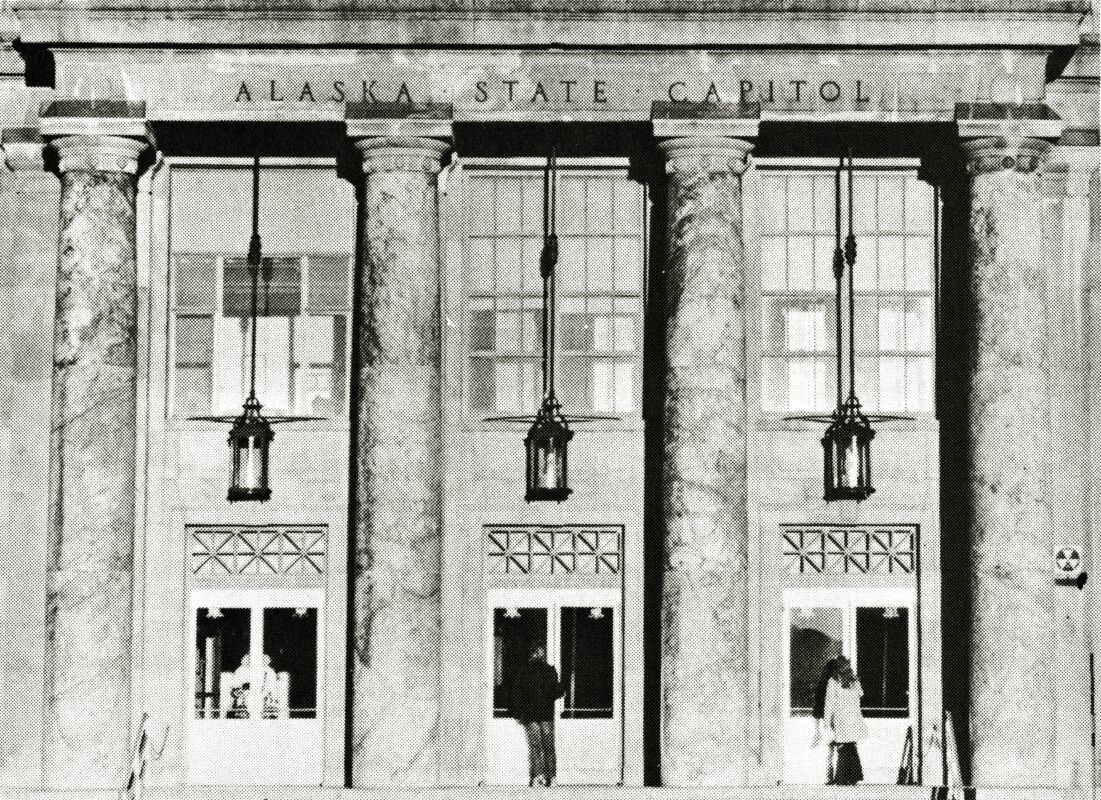
Nestled in the heart of downtown Juneau, the Alaska State Capitol may look like a typical government building at first glance — broad stone steps, a portico supported by four marble columns, and the flags of the United States and Alaska fluttering in the cold breeze. But behind its dignified Art Deco exterior lies a rich past filled with political transformation, architectural quirks, and yes — even a ghost story or two. As one of only eleven state capitols in the U.S. not crowned with a dome, this building has always gone against the grain. But its true intrigue? The whispers of history echoing through its marble corridors — some of them quite literally. For history buffs, political junkies, and especially paranormal investigators, the Alaska State Capitol is more than just a pretty face. It’s an extraordinary doorway into the eerie side of Alaska’s storied past.
The History
From Territorial Beginnings
Before Alaska became the 49th state in 1959, it was a U.S. territory — a remote and vast expanse largely overlooked by the Lower 48. Back then, the territorial legislature met in rented rooms scattered around Juneau, scarcely fitting the grandeur one might associate with statehood ambitions. In 1911, Congress authorized $200,000 for a permanent federal building, but World War I and difficulties acquiring the necessary land delayed the project for years. The appropriation proved insufficient, and it wasn’t until 1928 that Congress set aside $775,000 to make the building a reality. Citizens of Juneau themselves contributed funds to purchase the remaining land needed for the site and donated the property to the federal government. Construction of the Alaska State Capitol finally began on September 18, 1929.
The building was completed on February 2, 1931, and formally dedicated on Valentine’s Day of that year as the Federal and Territorial Building. Built under the oversight of James A. Wetmore, the Acting Supervising Architect of the U.S. Treasury Department, the building initially housed not only the territorial legislature but also the federal courthouse, a post office, and other federal offices. Notably, Wetmore was not an architect by training — he was a lawyer and administrator who oversaw the design work of the Treasury Department’s architectural staff, and he famously insisted on the title of “Acting” Supervising Architect out of respect for the professionals who did the actual design work. The building’s origin as a multi-purpose government hub adds to its layered energy — the perfect storm for paranormal enthusiasts looking to peel back the curtain of the past.
From Territory to Statehood
When Alaska achieved statehood in 1959, the building was transferred from federal to state ownership and rechristened the Alaska State Capitol. It became the epicenter of political change — a place where laws shaping the new state were debated and passed. Over the years, the building has undergone numerous renovations to modernize its interiors while maintaining historical integrity, including a major four-year, $33 million seismic retrofit and exterior restoration completed in 2016. The interior trim features light and dark Tokeen marble quarried on Prince of Wales Island in Southeast Alaska — stone extracted by the Vermont Marble Company, which operated quarries there in the early twentieth century. The exterior facade on its lower floors is clad in Indiana limestone, and the four portico columns are also carved from Alaskan Tokeen marble. Bronze light fixtures cast a soft glow reminiscent of the building’s early days.
The Capitol remains one of only eleven American state capitols built without a dome — a design choice reflecting the utilitarian philosophy of the era rather than any single cause. At its 1931 dedication, Alaska’s congressional delegate praised the building’s “modern office building type, wherein more attention is given to serviceable space and ease of access and use by a busy people, than to old-fashioned Roman architecture.” Its understated elegance and dramatic location against snow-covered mountains give it a unique charm all its own. And if you listen closely, you’ll hear that charm sometimes whispers back.
Architectural Highlights Worth Exploring
- Governor’s Office: Located on the third floor, this is where some of Alaska’s most important decisions have been made — and where the echoes of past debates may still linger. The executive office doors are crafted from black birch, with hand carvings depicting Alaskan industry.
- Senate and House Chambers: Found on the second floor, these chambers have been restored to reflect their original territorial appearance. The walls feature historic photographs from early Juneau photographers.
- Hall of Governors: A gallery of portraits of Alaska’s governors and lieutenant governors, stretching back to the territorial era, provides a sense of continuity — and maybe, for a few spirits, a sense of unfinished business.
The Haunt
Most visitors expecting paranormal activity in Alaska typically turn to its abandoned mining towns, desolate Arctic outposts, or the famously haunted Alaskan Hotel down the street. But the Alaska State Capitol has its own quieter reputation among those attuned to such things. The hauntings reported here are modest compared to some of Juneau’s more notorious locations, but they persist — woven into the lore of this building over many decades.
The Ghost of a Former Legislator
The most commonly reported presence in the Capitol is that of a former legislator whose spirit is believed to linger in the building’s corridors after hours. Those who have encountered this presence describe an unmistakable feeling of someone else being in the hallway — a sense of being watched or followed — even when the building has been cleared for the night. The identity of this spectral politician remains unknown, but the story has endured long enough to become a staple of Juneau’s ghost walking tours, where guides share the tale as visitors stand outside the Capitol’s stone steps.
An Unexplained Presence
Beyond the legislator legend, several visitors and staff have reported a more general sense of unease within the building. Some describe feeling an unexplained presence in certain areas, particularly in the upper floors and near the legislative chambers. While no dramatic apparitions or well-documented encounters have emerged, the accounts are consistent enough to have earned the Capitol a place on Juneau’s haunted history tours alongside far more famous locations like the Alaskan Hotel. Whether it’s residual energy from decades of intense political debate or something less easily explained, those who spend time in the building after the crowds have gone tend to agree: the Capitol feels different when it’s quiet.
A Place Where History Lingers
The Alaska State Capitol is more than a stop for political selfies or a peek into legislative history — it’s a place where the past feels unusually close. Whether you’re a seasoned ghost hunter or a history buff with a taste for the peculiar, this building offers a unique lens into Alaska’s past and the faint echoes that still linger within it. Its quiet corridors, timeless decor, and the persistent whisper of something just beyond perception offer a rare kind of adventure — one rooted in history and wrapped in mystery. The hauntings here may be subtle, but in a building where so many consequential decisions have been made, debated, and fought over, perhaps that’s exactly what you’d expect. Some Capitol deliberations, it seems, are never truly adjourned.