
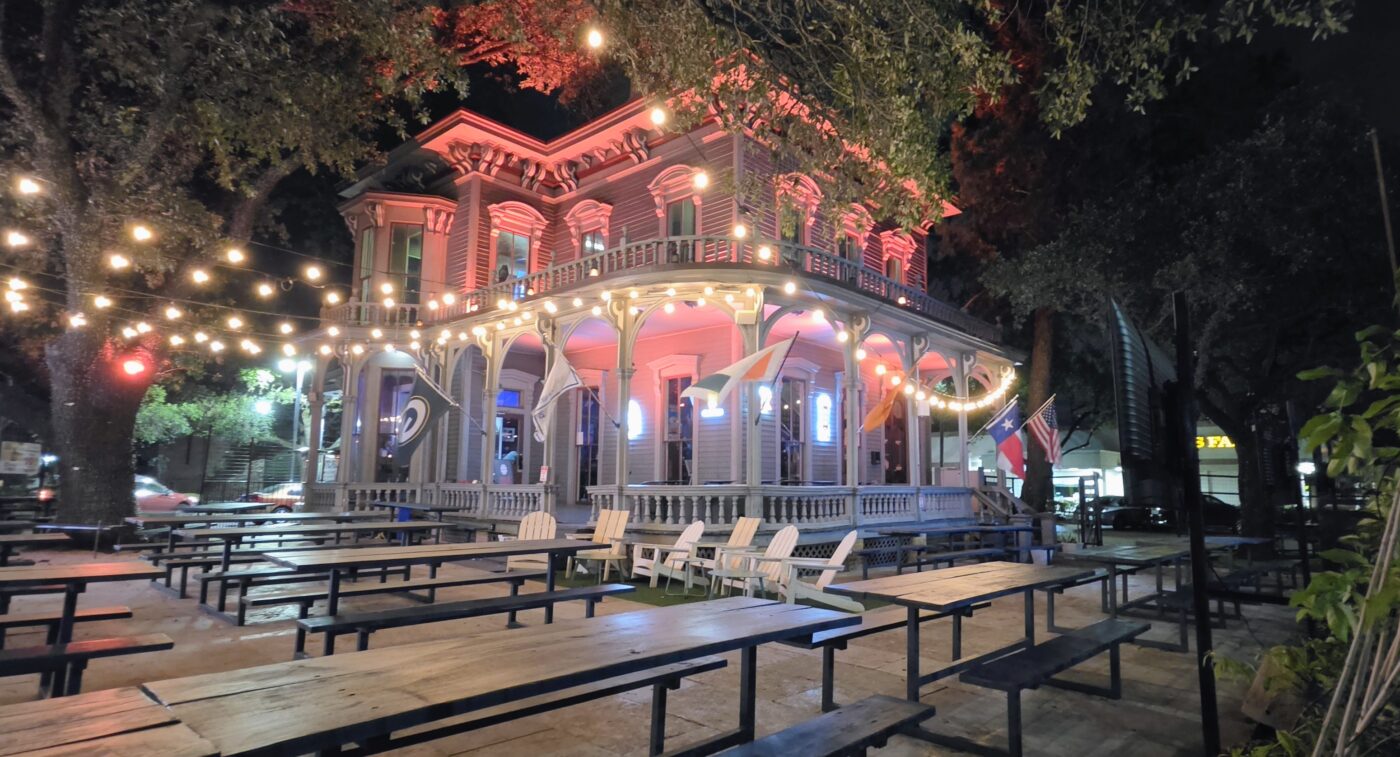
On the southeast corner of South Congress Avenue and West Oltorf Street, set back from the sidewalk behind a low iron fence and an enormous live oak, stands an ornate two-story Victorian that looks strangely out of place in the middle of Austin’s busiest hipster corridor. It does not belong to South Congress. It was never supposed to be here at all. And according to staff, tour guides, and regulars who have spent enough time inside, something in the house has never quite made peace with the move.
For years this was Freddo ATX, a Greek-owned coffee shop and cocktail bar. In early 2026 it reopened under new branding as Walter’s Tavern. But the house itself has carried the same name for a century and a half — the Walter Tips House.
The History
The house was built in 1876 for Walter Tips, a young German immigrant who had arrived in Texas as a boy and would, over the course of his life, become one of the most successful merchants in the capital. Tips was born in Elberfeld, Prussia in 1841, the youngest son of Johann Conrad Tips and Anna Caroline Brown Tips. The family sailed for Texas in 1849 and came ashore at Indianola, the port town on Matagorda Bay that no longer exists — a hurricane erased it entirely in 1886. Walter grew up in New Braunfels and was still in his late teens when the Civil War broke out. He enlisted in the Confederate Army as a volunteer, served through the duration of the war, and came home with the rank of 2nd Lieutenant.
His elder brother Edward had opened a small hardware store on Congress Avenue in Austin back in 1857. When Edward died in 1872, Walter and two partners bought the business and renamed it Walter Tips & Company. Tips eventually bought his partners out and built the enterprise into one of the most recognizable names in Texas commerce, selling hardware, mill supplies, automobile accessories, and sporting goods across a trade area that covered most of the state. The company would survive for 127 years, outliving its founder by nearly three-quarters of a century. He was also a founding director of the Austin National Bank.
In 1876, while he was breaking ground on the grand Italianate company building at 712 Congress Avenue that still stands across from the Paramount Theatre, he began building a home for his family on Bois d’Arc Street, just west of downtown. It sat adjacent to the famous Bremond Block, the cluster of Victorian mansions built by the banking and merchandising Bremond family that still anchors that corner of the city. The Tips house was wood-frame, two stories, with deep verandas and the tall narrow windows and bracketed cornices typical of the Italianate style. It is, today, one of Austin’s last surviving wood-frame Italianate houses.
Walter and his wife Johanna Mary Jane Pearce raised their family in the house. They had six children, though only five lived past infancy — the kind of quiet domestic grief that was routine in nineteenth-century homes and is almost always worth remembering when you are standing inside one. In 1893, Tips was elected to the Texas State Senate, where he served until 1896 and also sat on the State Penitentiary Commission. He continued to run his company until his death in 1911. He was seventy years old.
The house was remodeled in 1909, which gave it roughly the silhouette it still wears today. In 1925, fourteen years after Walter’s death, the property was sold to another prominent Austin businessman named Theo P. Meyer, who lived there with his family until his own death in 1966. After Meyer, the house sat empty.
By 1975 it had reached its hundredth year, and the city had scheduled it for demolition. What saved it was a bank — specifically, Franklin Savings Association, which bought the house, hired the architectural firm Bell, Klein and Hoffman to oversee a full restoration, and then did something dramatic. They picked up the entire two-story wooden structure and moved it. It was transported across downtown and reassembled on South Congress Avenue, where it was repurposed as a branch office. A Texas Historical Commission marker was installed in 1976 and the house was designated a Recorded Texas Historic Landmark. Franklin Savings eventually gave way to other financial tenants; for most of the later twentieth century, the building housed a Wells Fargo. Freddo ATX opened in the space in December 2021 and operated until early 2026, when it rebranded as Walter’s Tavern.
Nearly every commercial tenant who has worked there since the move has come away with the same impression: the house never really settled into its new address.
The Haunt
Freddo’s staff liked to tell new hires about Walter within a few shifts. They didn’t always introduce him by name, but the shorthand caught on quickly enough — when a door latched itself overnight, when a bottle fell off a well-anchored shelf, when the lights on the second floor flickered for no reason at all, someone behind the bar would shrug and say, “That’s just Walter.” It became a kind of pressure valve. A way of explaining away the small, unglamorous, unrepeatable things that kept happening in a building where nothing really should have been happening in the first place.
The activity in the Walter Tips House follows a pattern common to old residences where many generations of private life have unfolded, but the specifics here have been unusually consistent for decades. People report feeling watched when they are alone, particularly on the stairs and in the back hallways of the second floor. They describe disembodied voices and whispers, phantom footsteps from rooms upstairs when the upstairs is empty, and heavy thuds with no identifiable source. Doors rattle or swing open. Electrical systems behave strangely — lights dim or surge, appliances cycle on their own, cameras and phones drain or glitch in specific rooms.
The most striking reports, and the ones that have gotten the house the most attention online, involve the upstairs windows. Multiple guests and passersby, over a span of years, have described seeing the faces of children staring down at them from the windows on the second floor. The sightings were frequent and convincing enough that at one point, a customer who believed actual children were being hidden up there called Child Protective Services on the coffee shop. There were no children upstairs.
Staff and guests have also described a woman in the upstairs windows — older, watchful, often partially obscured. Some have described her as appearing “stuck,” the way certain presences in old houses are described by people who spend a lot of time inside them. Downstairs, the mood is different. Employees and visitors have reported a heavier, more oppressive presence on the first floor, especially near the back of the house and the base of the stairs. It is not openly hostile, but it is watchful and not particularly welcoming.
The Night Owl Podcast, an Austin-based paranormal investigation show, has devoted several long-form episodes to the property, interviewing the owners, staff, and multiple local tour guides, and returning with psychic mediums who were brought in blind to the location. Without being told where they were, mediums independently described an older trapped-feeling woman, children’s energy, a man with a large mustache (Walter Tips was known for his), and — perhaps most notably — the distinct impression that the house itself had been moved. One of them commented on the side paneling “jiggling,” as if the structure remembered being lifted off its foundation and carried somewhere it did not choose to go.
Whether any of that persuades you is a matter of temperament. What is harder to dismiss is the quiet consistency of ordinary employees, across different businesses occupying the same walls for the better part of fifty years, reporting the same small phenomena in the same rooms. Franklin Savings staff described things they could not explain. So did the bank tellers who came after them. So did the baristas. So, now, do the bartenders.
If there is a presence in the house, it has had a great deal of time to get used to being there, and to being disturbed. Walter Tips lost an infant child under its roof, built a life and a business and a political career out of its front door, and died within its walls. The house was then ripped from the only piece of ground it had ever known and rebuilt on a stretch of South Congress that would not have been recognizable to him, surrounded by traffic and food trucks and a skyline he would not have understood. Whoever or whatever is still inside, they have had reason to be unsettled.
Visit during the day and the house feels warm, almost inviting — morning light through the tall windows, a patio under the oak trees, the smell of espresso drifting out the open doors. Stay until closing. Walk up the staircase after the last customer has gone. Look up at the second-story windows from the sidewalk on your way to your car.
If something looks back, you’ll know who it is. Everyone who works there already does.