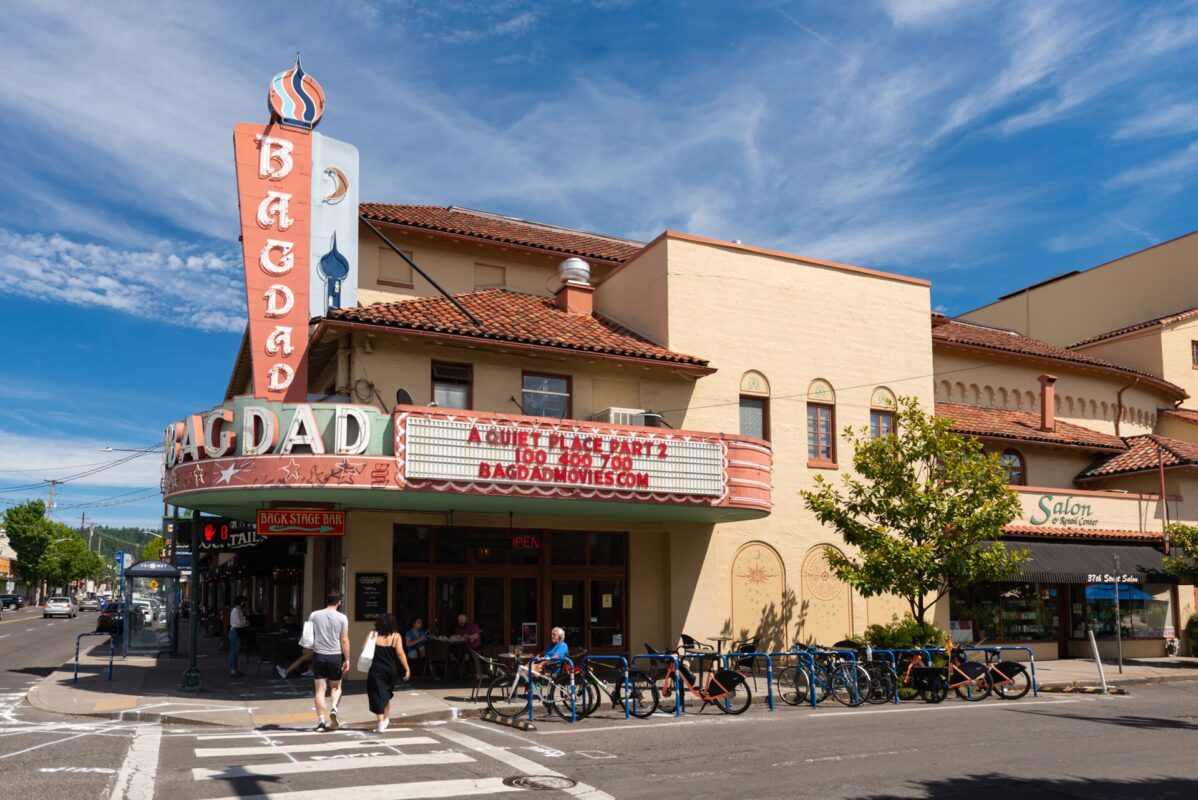
If you love old movie palaces, Pacific Northwest history, or simply the pull of places that time refuses to let go of, the Bagdad Theater in Portland, Oregon belongs on your list. Sitting on the corner of SE Hawthorne Boulevard in the middle of one of the city’s most walkable, most eclectic districts, the Bagdad has spent nearly a century doing the same thing: filling a room with people in the dark. Some say not everyone who came for a show has left. Whether you’re there for a first-run film, a pint from the pub, or something a little harder to explain, the Bagdad offers an experience unlike anything else in the city. Pull up a seat and let the lights go down.
The History
The Bagdad opened its doors on the evening of January 14, 1927, and Hawthorne Boulevard has probably never looked like that before or since. The street was roped off for a block dance. Searchlights raked the sky. Portland’s mayor gave a speech about what the building would mean to the neighborhood. Inside, an orchestra played, a male quartet sang, and the screen lit up with Laura La Plante in Her Big Night. The theater billed itself as an “Oasis for Entertainment,” and for one night at least, the whole east side seemed to believe it.
The building was the work of the Multnomah Theater Company, financed in substantial part by Universal Pictures, which put roughly $100,000 into the project — an enormous sum at the time, and a sign of how badly Hollywood studios wanted showcases for their new talking pictures. The architects were Thomas and Mercier, and what they produced was a fantasy of the Middle East filtered through 1920s American imagination: stucco over reinforced concrete, terra cotta detailing, painted murals, and a marquee that once stretched clear across the street to the building opposite. The name itself was a piece of showmanship. The “h” was quietly dropped from “Baghdad” to make it read as more American. Before any of it existed, the site held a cider works.
Inside, the original auditorium seated somewhere around 1,400 across a main floor and a balcony, with a full stage and an orchestra pit — because in 1927, a movie house was also a vaudeville house. Through the 1930s and 1940s, the Bagdad ran newsreels, cartoons, and features alongside live acts working the traveling circuit. For decades, “Meet me at the Bagdad” was shorthand in that part of the city.
Television ended vaudeville, and the multiplex boom nearly ended the Bagdad. By the 1970s the theater was being carved up: the balcony walled off into its own screening room, the backstage area converted into a small art house. There were bright moments — in 1975 the Bagdad hosted the Oregon premiere of One Flew Over the Cuckoo’s Nest, with the film’s stars in attendance — but the trend was one direction. The original owners closed the theater at the end of the decade, and it sat dark.
Rescue came in 1991, when brothers Mike and Brian McMenamin bought the building and set about undoing forty years of subdivision. They pulled down the wall separating the balcony, returned the room to a single auditorium, added pub seating and long tables, and put a bar where a bar had no business being — which is, of course, exactly the McMenamins approach to historic property. The theater reopened and promptly hosted the premiere of My Own Private Idaho. The old backstage space eventually became the Back Stage Bar, a strange, tall, three-story room tucked behind the screen. A 2013 renovation brought in a larger screen, digital projection, upgraded sound, and new seating.
The Bagdad had already been recognized by then. It was added to the National Register of Historic Places on March 8, 1989, and it carries Portland Historic Landmark status as well. Very few American movie palaces of its generation are still doing what they were built to do. The Bagdad is one of them.
The Haunt
A century of continuous operation leaves residue, and the Bagdad has accumulated its share. Nothing here is theatrical in the marketed sense — you won’t find cobwebs in the lobby or a plaque pointing out the haunted seat. The stories circulate quietly, mostly among people who work there, and most of them are small.
The most persistent involves the backstage area. Local lore holds that a stagehand or maintenance worker died by his own hand somewhere behind the screen, and that he never entirely left. Staff and patrons have described whispering from behind the screen when the house is empty, and, occasionally, the impression of a figure crossing in front of it and continuing into nothing. It’s worth saying plainly that no confirmed record of such a death has surfaced. The story has been repeated long enough that it functions as fact locally, but the paper trail hasn’t been produced.
The second-most-cited location is far less dramatic and, by many accounts, far more unsettling to actually experience: the women’s restroom. Reports there are consistent and physical rather than visual — the sensation of breath at the back of the neck, of being brushed past in an empty room, of being watched closely enough that people leave before they meant to. Ask around the building and you’ll find this one is widely known among staff.
Smaller things fill in around the edges. Children have been heard running in the aisles — and reportedly stop the instant someone tells them to. Cold drafts move through the auditorium in warm weather. Lights dim without a cue. Doors close on their own. Some staff mention the smell of an old-fashioned men’s cologne with no source, and the strong feeling of company while alone. Not everyone finds it unpleasant; at least one employee has described the presence in the building as feeling protective rather than threatening, more like a relative looking over your shoulder than anything hostile.
That’s the character of the Bagdad’s haunting overall. It isn’t loud. It doesn’t announce itself. It behaves like something that has simply been in the room a very long time.
Go for the building first, and let the rest happen or not. Sit under the painted ceiling before the lights drop and consider that people have been doing exactly this in exactly this room since 1927 — through vaudeville, through the talkies, through the decade the place nearly died and the decade it came back. Order something from the bar. Wander back to the Back Stage. Take the stairs slowly.
And if you find yourself glancing up at the balcony between reels, or standing a little straighter in the restroom mirror, you’ll be in good company. The Bagdad has been collecting that particular feeling for close to a hundred years, and it shows no sign of letting any of it go.