South Carolina is a treasure trove of Southern charm, historic grandeur, and eerie tales from centuries past. Nestled in the heart of this mystique is the Abbeville Opera House — a landmark that is equal parts cultural beacon and paranormal enigma. For lovers of the arts, history buffs, and ghost hunters alike, this ornate theater offers more than dazzling architecture and stage performances. It tells a story layered with over a century of triumphs, transformations, and ghostly tales whispered in the shadows. What follows is what the record actually supports, both about the building and about the spirits said to linger in it.
The History
The Opera House was designed by William Augustus Edwards of Edwards and Wilson, opened in 1904, and dedicated in 1908. Abbeville was a railway stopover for the “road companies” traveling the eastern seaboard between New York and Atlanta, so the town built an opera house into its new municipal building — a detail worth noting, because the theater is not a freestanding playhouse. It still shares the structure with the town’s City Hall; walk past the administrative offices and you reach the auditorium.
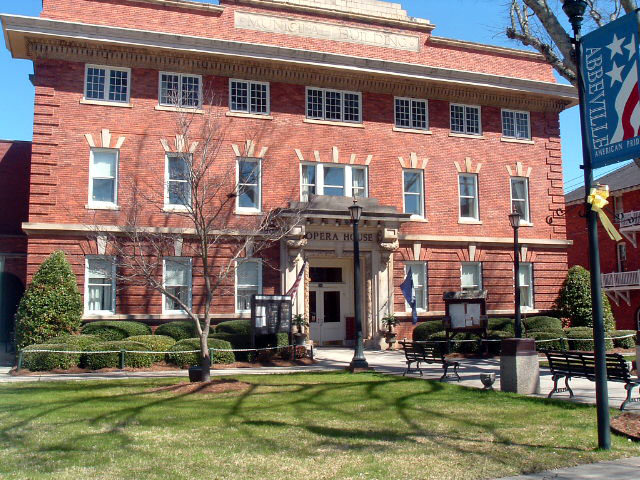
The architecture was ambitious for a small upstate town. The three-story brick building is Beaux-Arts classical in style and sits on Abbeville’s public square next to the county courthouse, with unusual brickwork on the main floor that includes a starburst design around the keystones, an elaborate entrance crowned by large diminishing stone slabs, masonry quoins, and a large entablature with dentils and fretwork. Rather than copying European models, the design closely followed Atlanta’s Grant Theatre and Richmond’s Lyric, with a 7,500-square-foot stage sized to accommodate large touring casts. The hall hosted vaudeville, minstrel and burlesque troupes working the circuit between New York and Atlanta, along with musicals, Broadway shows, the Ziegfeld Follies, and performers such as Jimmy Durante and Fannie Brice.
Beginning in the 1920s the building also became a popular venue for motion pictures, which eventually replaced live theater on its stage entirely. During the 1940s Paramount Pictures listed the Abbeville Opera House among its motion picture theatres, an arrangement that lasted well into the 1950s under the Wilby-Kincey name. It continued as a movie house until the 1950s, when television undercut theaters nationwide. The space then sat largely unused until the late 1960s, when a local community theater group launched a campaign to restore it and return it to live performance.
That restoration was completed in 1968. The building was added to the National Register of Historic Places on July 1, 1970, and the South Carolina Department of Parks, Recreation and Tourism notes that the theater has received the South Carolina Governor’s Travel Award for Tourism and carries the designation of Official Rural Drama State Theatre of South Carolina. Today the Opera House is restored to its turn-of-the-century appearance, with air conditioning and rocking chairs as the two modern concessions to comfort. The curtain is still raised and lowered on the same rope-pulled rigging installed in 1908, making it the only remaining “hemp house” in South Carolina, and the theater draws more than 20,000 visitors a year across its winter and summer seasons. It operates at 100 Court Square and programs concerts, comedy, plays, and children’s shows.
The Haunt
The Opera House’s ghost stories are modest in scale but unusually well established — they appear in state tourism material and local histories, not only on paranormal sites.
When the theater was restored, the upper balcony was cleared of seating except for a single chair, known locally as the “ghost chair,” which is left undisturbed. The seat is kept reserved and a light is kept burning over it at all times. There is a practical explanation for the empty balcony as well: the fire marshal ordered the furniture removed shortly after the building reopened, and for the same reason no one is allowed up there during rehearsals or shows.
The chair is associated with the theater’s best-known figure. South Carolina’s official tourism site describes it as left for the ghost of a young actress who fell ill and died during a performance. Another version holds that she was a touring actress who became sick on a train ride and died in town. One reported sighting has an actor glancing up during a show and seeing a woman standing in the second balcony, staring down at the stage; another account describes a woman in period dress applauding from that balcony during a curtain call. A version attributed to the theater’s own management describes the figure rising from the chair during a standing ovation after a successful performance and joining the applause.
Superstition around the chair is part of the tradition. A set builder quoted in a 2005 South Carolina newspaper article said he would not move or even touch it for fear something would go wrong during the show — the curtain failing to come down, or the lights going out — a belief echoed in local accounts that something will go awry in the play if anyone touches her seat.
A second spirit is rumored to occupy the backstage areas: an African-American workman said to have died during the theater’s construction. A local tour guide interviewed for a 2019 South Carolina ETV segment described him as a construction worker who fell to his death from a seventy-foot wall in 1908, and who is said to bang pipes and make props disappear
Beyond the two named figures, the reports here are low-key: odd sounds, footsteps on the catwalk, and movement caught at the edge of vision.
One legend deserves a caution. Because the upper balcony was formerly the segregated seating area for Black patrons, speculation has circulated that the apparition is the victim of a racially motivated crime. No documented crime supports that connection; the only known violent death in that part of the building was the shooting of a Black suspect who had escaped the sheriff’s custody around 1915. Anyone researching the site should treat the racial-crime version as folklore rather than record.
Planning a Visit
The appeal here is not high drama. There are no widely reported physical encounters, no aggressive activity, and no long history of overnight investigations at this location — what the Opera House offers instead is an unusually intact 1900s theater with a ghost tradition that the building’s own staff and the state tourism board acknowledge openly. The theater sits on Court Square beside the county courthouse and is open weekdays from 8:30 AM to 5 PM for self-guided tours. The box office keeps the same weekday hours and opens an hour before each performance.
Because the building is city-owned and shares space with municipal offices, access is a matter of asking the city rather than a property owner. Attending a performance is the easiest way to see the reserved chair and its light in the upper balcony, and it puts you in the room where nearly every reported sighting has taken place.