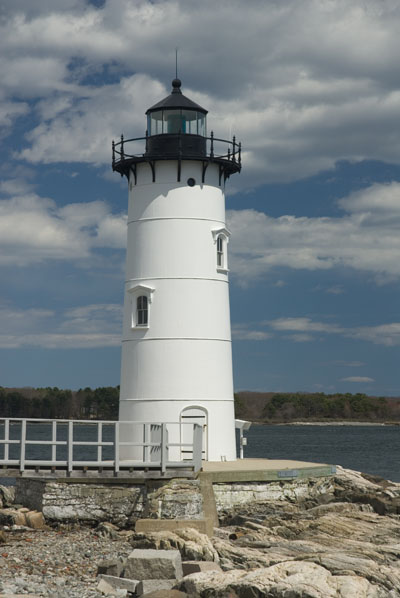
New England’s rugged coastline is dotted with relics of maritime history, but few are as captivating—and perhaps as haunted—as Portsmouth Harbor Lighthouse in New Castle, New Hampshire. Nestled within Fort Constitution State Historic Site, this centuries-old lighthouse stands as a sentinel over the Piscataqua River and the entrance to Portsmouth Harbor. It offers more than just sweeping ocean views. For history buffs and paranormal investigators alike, this lighthouse is a goldmine of untold stories, ghostly legends, and fascinating past lives. If you’re looking for a scenic adventure with a spectral twist, Portsmouth Harbor Lighthouse is calling your name.
The History
Early Beginnings (1771–1800)
The origin of Portsmouth Harbor Lighthouse dates back to 1771, making it one of the oldest lighthouses in the United States. It was the first lighthouse built north of Boston in the American colonies, and the tenth of eleven light stations established before the American Revolution. Constructed under British rule at what was then known as Fort William and Mary, its initial purpose was the same as it is today: guiding ships safely through the fast-moving and treacherous currents of the Piscataqua River. The original structure was a shingled wooden tower, roughly fifty feet tall, topped by an iron lantern with a copper roof and illuminated by three copper oil lamps. The first keeper was the commandant of the fort, and the lighthouse served both as a navigational aid and a fixture of the colonial military installation.
The lighthouse appears to have gone dark during the Revolution, from roughly 1774 to 1784, though it continued to serve as a lookout post during the war. The fort itself played a pivotal role in early revolutionary action — in December 1774, Paul Revere rode from Boston to warn the colonists of British plans to reinforce the garrison, prompting a raid in which locals seized gunpowder and cannons. After the war, the fortifications were eventually renamed Fort Constitution, and in 1791 the lighthouse was transferred to the federal government. In 1793, President George Washington ordered that the light be maintained at all times, with a keeper living on site.
A New Wooden Tower (1804–1878)
By the turn of the 19th century, it became evident that the original wooden structure could not stand the test of time. In 1804, a new eighty-foot octagonal wooden lighthouse was constructed approximately one hundred yards east of the original tower. This second tower served its purpose for several decades, though its height was reduced to fifty-five feet in 1851 following the establishment of nearby Whaleback Lighthouse, which diminished the need for such a tall harbor beacon. In 1854, the tower was fitted with a fourth-order Fresnel lens, significantly improving the brightness and reach of the light.
The truly iconic transformation came in 1878 when the current forty-eight-foot cast-iron tower was erected on the foundation of the previous structure. In a remarkable feat of engineering, the new lighthouse was actually assembled inside the old wooden tower, which was then removed around it. The cast-iron segments were prepared at a foundry in Portland, Maine, and the resulting brick-lined tower continues to stand today — a handsome and durable example of the lighthouse construction methods developed during that era.
The keeper’s house, built in 1872 on the foundation of an earlier dwelling, also still stands. It served as the residence for generations of lightkeepers and their families and has since been moved twice within the fort grounds to accommodate military battery construction. Many keeper records persist, preserving a glimpse into the maritime lives of those who once maintained the light by hand, braving brutal winters and isolation to ensure the safety of passing ships.
Modernization and the Lighthouse Today (1900–Present)
Like many historic lighthouses, Portsmouth Harbor Lighthouse saw numerous technological upgrades in the twentieth century. The light was electrified in 1934 and fully automated in 1960. The last full-time keeper departed the station in 1948, closing a long chapter of hands-on stewardship that had defined the lighthouse for nearly two centuries. Yet the lighthouse continued to shine, literally and figuratively, as a vital maritime beacon. Its fourth-order Fresnel lens remains in use to this day, producing a fixed green light visible for twelve nautical miles.
Today, Portsmouth Harbor Lighthouse is cared for by the Friends of Portsmouth Harbor Lighthouses, a chapter of the American Lighthouse Foundation, under a license with the U.S. Coast Guard, which continues to own the structure and maintain its navigational equipment. The group conducts regular tours and special events aimed at preserving the lighthouse and educating the public about its storied past.
As much as the lighthouse serves as a piece of living history, it has also become a focal point for something far less explainable — paranormal activity.
The Haunt
Portsmouth Harbor Lighthouse is one of New England’s most quietly compelling haunted locations. While it may not scream “ghost story” at first glance, speak to any of the local volunteers, Coast Guard personnel, or paranormal teams who have investigated the site, and you’ll hear tales that may send a chill down your spine.
The Keeper Who Never Left
The most prominent and consistently reported spirit at Portsmouth Harbor Lighthouse is that of a former keeper who served at the station for thirty-five years, from 1874 to 1909 — one of the longest tenures of any keeper at a single lighthouse. He was a beloved figure in the community, known for his dedication and his sense of humor. As part of his uniform, he wore a cap emblazoned with the letter “K” surrounded by a wreath. When visitors asked what the letter stood for, he would reply, “Why, Captain, of course.” He reportedly loved life at the lighthouse so much that he rarely took any time off, and when he was finally forced to retire in his late eighties due to failing health, some accounts suggest he left against his will. He passed away just two years later, in 1911.
Since his death, sightings attributed to this keeper have persisted for over a century. Coast Guard personnel stationed at the nearby building have reported observing a shadowy figure roaming the grounds at night. One visitor, touring the lighthouse in broad daylight, reported seeing a man standing on the wooden walkway in front of the tower wearing an old-fashioned keeper’s uniform. Assuming he was a costumed tour guide, she thought nothing of it — until the figure vanished before her eyes. Shaken, she made her way to the nearby Coast Guard station, where she noticed historical photographs on display. She immediately identified one of the former keepers as the man she had seen. On at least two other occasions, visitors have independently reported seeing a man in a pea coat and hat walking near the tower as though tending to his duties, only for the figure to disappear. One of these witnesses also later identified the same keeper from a photograph.
Phantom Footsteps and Disembodied Voices
Unexplained sounds are among the most frequently reported phenomena at the lighthouse. Visitors and investigators alike have documented footsteps echoing inside the empty tower, as if someone were pacing the iron spiral staircase. Disembodied voices have been heard in the circular watchroom at the top of the tower — a space with three portholes where many strange happenings have been reported. In one case, a lighthouse enthusiast visiting the watchroom clearly heard voices, only to discover she was completely alone. In another instance, a visitor heard a male voice ask, “What are you doing?” and turned to find no one there.
Perhaps the most well-known voice incident occurred in 2007, when a lighthouse historian was giving a tour to a young couple. All three heard a clear, unexplained voice say “HELLO” inside the tower. The historian asked the couple if they had heard something. The man confirmed he had heard a male voice say hello, while his wife had heard nothing. The incident was later recounted on a nationally broadcast NPR program.
In the keeper’s quarters — the 1872 house that now serves as Coast Guard offices — volunteers and personnel have reported hearing footsteps on the upper floors and a fan rattling on its own in the area that once served as the keeper’s bedroom. During one paranormal investigation, a team heard voices and the slamming of a door in the basement, despite the absence of any wind drafts. The sounds were captured on recording equipment.
The Fort Constitution Connection
Adjacent to the lighthouse, the ruins of Fort Constitution add another potent layer to the site’s paranormal reputation — and a deeply tragic piece of history that may explain some of the activity. On July 4, 1809, gunpowder that had been set aside for a holiday fireworks display accidentally exploded at the fort, killing a number of soldiers and civilians, many of them children. Some accounts place the death toll at ten, others as high as fourteen. The blast was so powerful that some of the victims’ remains were reportedly thrown toward the lighthouse. Many believe the residual energy of this catastrophe still haunts the grounds.
Today, visitors to the fort report a heavy, oppressive feeling in their chest when walking through the sally ports — the arched stone passageways that served as entryways. Some have claimed to see an apparition darting around a corner near the lookout tower. Members of the Coast Guard have reported being reluctant to enter the fort at night due to the unexplained noises they hear within its walls. Strange photographs, including images of unexplainable green smoke, have also been reported by visitors exploring the fort after dark.
Investigated on Television
The paranormal reputation of Portsmouth Harbor Lighthouse drew national attention when it was featured as the Season 4 finale of the television series Ghost Hunters on the SyFy Channel, airing in December 2008. The TAPS (The Atlantic Paranormal Society) team was invited onto the active Coast Guard property to investigate the lighthouse, the keeper’s quarters, and Fort Constitution. The investigation was prompted by years of late-night reports from Coast Guard personnel and civilian witnesses.
During the overnight investigation, two of the three teams heard unexplained footsteps on the lighthouse stairs while all team members were confirmed to be in the tower above. In one memorable moment, two investigators were able to establish a back-and-forth communication through knocking — they would knock a pattern on the railing, and something unseen would knock back in response. The investigation yielded enough compelling evidence that the team considered the location one of its more intriguing cases.
A Beacon Between Worlds
Whether you are captivated by lighthouse history or drawn to places where the boundary between past and present feels thin, Portsmouth Harbor Lighthouse offers a rare blend of both. With more than 250 years of maritime legacy and a catalog of ghostly encounters reported by Coast Guard members, historians, casual visitors, and paranormal investigators alike, it stands as one of New England’s most credible and compelling haunted sites.
The lighthouse and the surrounding ruins of Fort Constitution — scarred by revolution, tragedy, and centuries of Atlantic weather — create an atmosphere unlike almost anywhere else on the coast. The stories here are not just campfire tales. They come from people who were not looking for ghosts and were startled by what they found, from trained investigators who captured sounds they could not explain, and from a keeper whose devotion to his lighthouse apparently did not end with his life.