
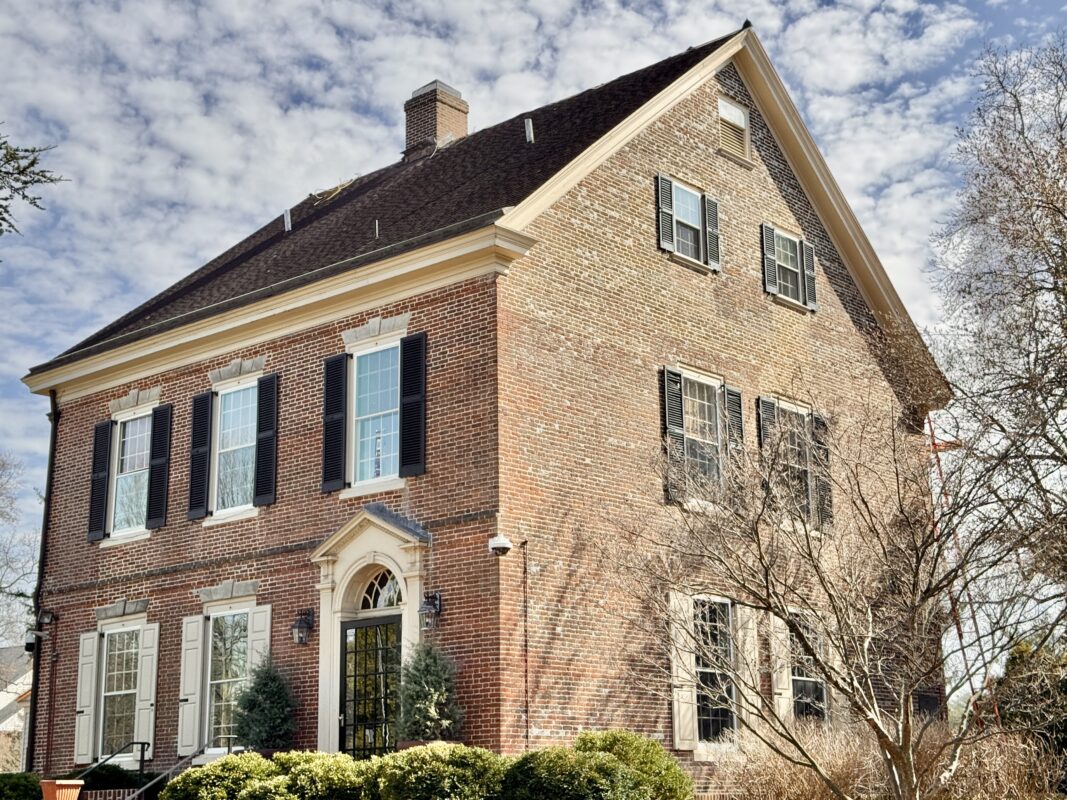
In the heart of Dover, Delaware stands a stately Georgian mansion that is far more than a government residence — it is a living relic of American history, with more than two centuries of ghost lore woven through its halls. This is Woodburn, the official Governor’s Residence of Delaware, known equally for its colonial past and its reputation as one of the First State’s most enduringly haunted homes. Whether you come as a history buff, an architecture enthusiast, or someone drawn to the unexplained, Woodburn offers a rich tapestry of stories that stretch back to the earliest days of the republic — from colonial politics and the Underground Railroad to a set of remarkably good-natured ghosts.
The History
A Colonial Legacy
The land beneath Woodburn was part of a large tract granted to the Hillyard family in the seventeenth century. Charles Hillyard III acquired the property at a sheriff’s sale in the 1780s for the modest sum of $110, and around 1790 he completed the elegant home that would come to be called Woodburn. (The state’s own history gives a construction date of circa 1798, but most historians and the National Register documentation place it around 1790.) A fine example of Middle Period Georgian architecture, the two-story brick house — laid in a Flemish bond pattern, with a distinctive fanlight over a large Dutch door — remains one of the best-preserved homes of its era in Delaware.
Rather than passing through anonymous hands, Woodburn stayed close to its founding family for a time. Hillyard’s daughter Mary and her husband, Martin W. Bates — a doctor, merchant, lawyer, and U.S. Senator — inherited the home. In 1820, Bates leased it to Governor Jacob Stout, the first time Woodburn served as an executive’s residence. In 1825, Bates sold the house to Daniel and Mary Cowgill. Daniel Cowgill, a devoted Quaker and abolitionist, freed the people his family had enslaved and welcomed them to gather in the great hall. During the 1840s and 1850s, Woodburn is widely believed to have served as a station on the Underground Railroad — a tradition supported by the home’s location near the St. Jones River and by Cowgill’s convictions, though firm documentary proof is elusive. Over the following century the home passed through a succession of prominent Delaware families, including gentlemen farmers, senators, physicians, a dentist, and a judge.
Becoming Delaware’s Executive Residence
In 1965, the state of Delaware purchased Woodburn to serve as the official residence of the Governor, beginning with Governor Charles L. Terry, Jr. His wife oversaw a careful restoration, furnishing the house with pieces from the period of its construction, and an open house was held in February 1966. Woodburn has served as the Governor’s Residence ever since — and at roughly 3,500 square feet, it holds the distinction of being one of the smallest governor’s mansions in the country.
Despite its official function, the interior remains rich with period detail: antique furnishings, portraiture, and original architectural elements that reflect the home’s long lineage. It is one of the few governor’s residences in the United States that functions as both a historic site and a working family home — a true living museum, listed on the National Register of Historic Places since 1972.
The Haunt
The Man on the Staircase
Woodburn’s reputation as a haunted house is nearly as old as the house itself, and its best-documented ghost is generally believed to be the builder, Charles Hillyard III. The earliest recorded encounter dates to around 1815, when the owners at the time, Dr. and Mrs. Martin Bates, hosted a traveling Methodist preacher overnight. Coming down to breakfast, the guest mentioned passing another gentleman on the staircase — an older man in a powdered wig, knee breeches, and a ruffled shirt, dressed in the fashion of a bygone generation. The Bateses were unsettled: there were no other guests, and the description matched Mrs. Bates’s late father, Charles Hillyard, precisely. In the two centuries since, other residents and owners have reported passing the same figure on the stairs and describing him in much the same way.
The Wine Lover
Hillyard was, by local tradition, a man who enjoyed a strong drink — and that fondness reportedly followed him into the afterlife. The most famous Woodburn legend holds that a glass or decanter of wine left out downstairs overnight would sometimes be found emptied by morning. One owner said he refilled an antique decanter each night only to find it drained; another governor reported the apparition of a man in a white wig helping himself in the dining room. The tale grew well known enough that one governor’s wife, a self-described light sleeper, would leave wine out to test the story — though in her case the glass always remained stubbornly full.
The Little Girl and Other Presences
A gentler presence is said to be a young girl in a red-checked gingham dress, first reported around the property’s garden pool in the 1940s, where she seemed to enjoy the water and fountains. Guests at a 1985 gubernatorial inauguration reportedly felt a tugging at their clothes during the festivities before glimpsing a small figure lingering shyly in a corner of the reception room. Other accounts describe a figure in Revolutionary War–era dress that drifts through the rooms, footsteps on the stairs at hours when no living person could account for them, and the general sense — common to old houses with long memories — of not being quite alone.
A Darker Legend
Not every Woodburn story is so benign. The property’s Underground Railroad history gave rise to its most somber tale: that a slave raider, pursuing freedom-seekers to the house, met his end when he became caught in a large poplar tree on the grounds and died there. According to local lore, his moans and the rattle of chains can still occasionally be heard near the tree — a grim counterpoint to the home’s otherwise friendly spirits.
Woodburn’s ghosts have drawn attention beyond the state’s borders as well; the wine-drinking legend was featured on the paranormal television series Casefiles: Unknown, which aired on Destination America.
Plan Your Visit
If you’re drawn to the meeting place of history and the unexplained, few spots reward the curious quite like Woodburn. Here, eighteenth-century architecture, the sober legacy of the Underground Railroad, and a set of unusually convivial ghosts share the same address. It’s worth noting that Woodburn is an active governor’s residence, so access is not always open — public tours have historically been available by appointment, but availability changes with each administration, and at times tours are suspended entirely. The house is located at 151 Kings Highway in Dover.
The best approach is to check ahead through Woodburn’s official state website or watch for one of Delaware’s seasonal open-house or historic events, when the doors are most likely to be open. Whether or not a spirit chooses to make itself known during your visit, Woodburn offers something rare: a chance to stand inside a genuine piece of early American history that, by many accounts, has never quite been vacated.